Showing posts with label film. Show all posts

Sunday, November 6, 2016

[Zootopia SPOILERS] Interpreting Nick and Judy for Fan Fiction; or, the Question of Who Is More Mature

"Smort!"
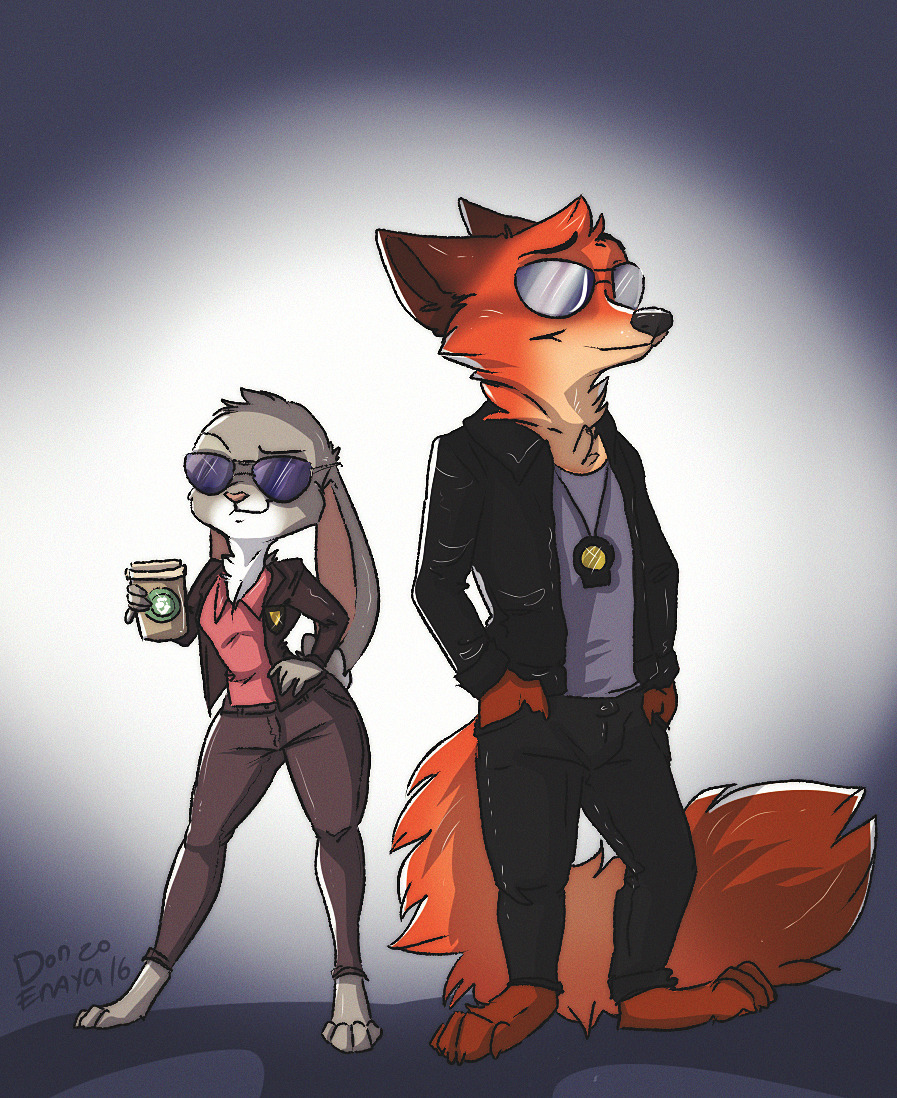
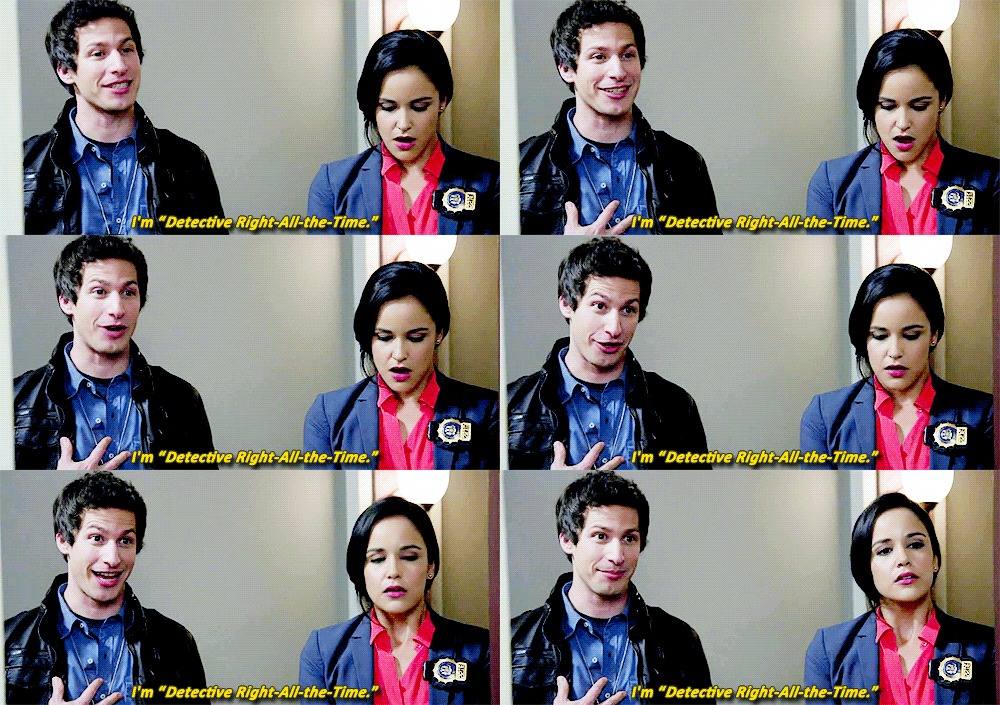
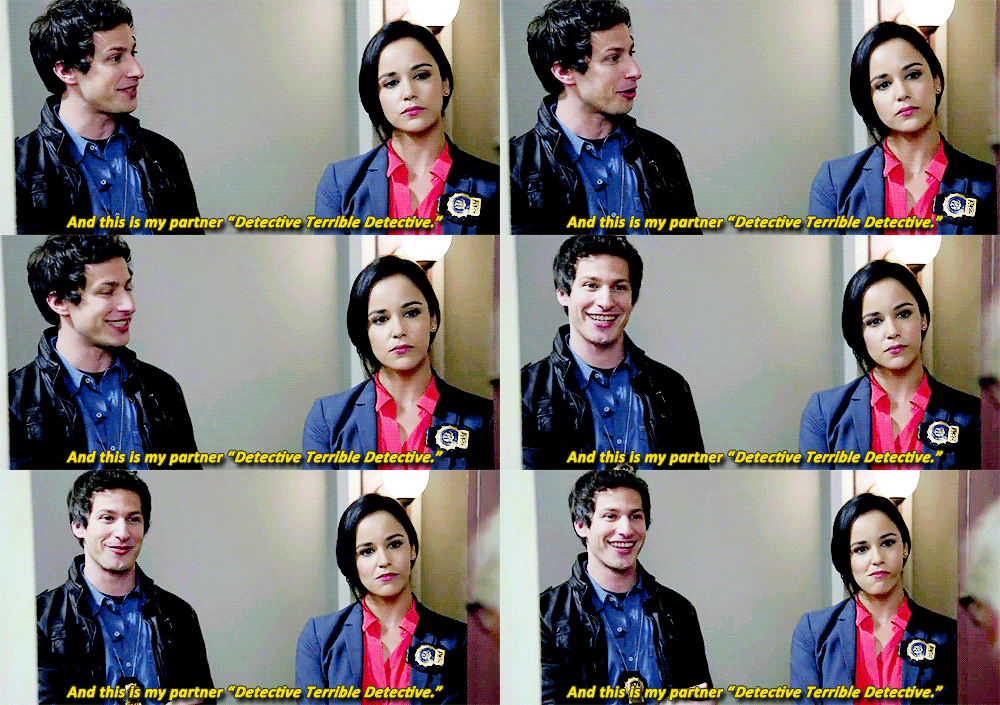
When I first watched Zootopia, Nick Wilde and Judy Hopps distinctively reminded me of Jake Peralta and Amy Santiago in Brooklyn Nine-Nine. As the illustration shows, I was not the only one who noticed. While Jake Peralta is the lead character of Brooklyn Nine-Nine, Amy Santiago is an equally strong character in the main cast. The two characters are amicable coworkers who often clash with one another, in an eerily similar way that Nick and Judy struggled in the first act of the movie.


Like Judy Hopps, Amy Santiago is a competitive young woman who is determined to prove how tough she is. She is also quite a stickler for the rules and often has to call out Jake whenever he is less-than-professional in his ways. While Jake and the rest of the Nine-Nine detective squad do respect her and take her seriously, they don't miss the chance to tease her, often insinuating that she is childish or old-fashioned or even unskilled. While she is good at her job, Jake manages to be a quicker thinker than she is, with less effort.

Like Nick Wilde, Jake Peralta is witty, snarky, and has a big heart under a flippant attitude. While Jake has had a tough childhood, it had more to do with having a broken family than any sort of bullying. He also clashes with his superior Captain Raymond Holt but comes to respect him more as the series progresses; not unlike Nick's burgeoning relationship with Chief Bogo.

But that is where the similarities end. In a way, Judy Hopps has a bit of Jake Peralta in her, too. While Jake is openly rebellious toward his strict boss, Captain Holt, because he prefers go off on his own path where he thinks his own way of solving crimes is more efficient, Judy goes against regulations because of a misplaced sense of righteousness. With Judy being Nick's superior by the end of the movie, we don't exactly see how Nick performs on his new job as a cop.

But what's beautiful about Zootopia is that it maintains an element of mystery regarding its two leads. We see nothing of Judy in the fifteen years between Gideon Grey's attack and training at the Zootopia Police Academy. All we know about Nick is that a traumatic event at age 9 destroyed his optimism while a combination of poverty and discrimination had him running marginally legitimate and ethically questionable hustles every day for 20 years from the age of 12. The rest of the movie spans two days, a montage that spans three months, and an indeterminate time skip between the climax and the epilogue. The narrative is chiefly plot-oriented, leaving plenty of room for interpretation for the characters involved. It also helps that the narrative acknowledges that personalities are multifaceted; nobody is fully good or evil, and that even some biases are justifiable.

Much of the ambiguous elements of the movie are intentional, and cleverly so. While there are a myriad of interpretations of the characters through Zootopia fan fiction, the interpretation for Nick and Judy is surprisingly consistent. Apparently, fans regard Judy as the "more mature" half of the pair while Nick doesn't really take anything seriously. While this can (and has been) done pretty well in the many pieces of fan fiction I've read, something about the idea feels a little off, to me.

Nick is usually written as a slob who is good at his job but otherwise favors fun over work to the point of being lazy sometimes, which is problematic to me. You don't make "200 bucks a say, 365 days a year" for 20 years by being lazy. I don't imagine Nick being dependent on Judy for anything. I don't think his ego could handle that. Furthermore, I think having a legitimate career would be so fulfilling for him that he would be dedicated to it, so he could keep it and his Carrots.

The "lazy, immature Nick" idea is usually lifted from a set of concept art by digital artist Armand Serrano including the pitiful state of Nick's apartment, which is a leaky basement in a building in the Rainforest District. We never see this apartment in the movie, but fans accept it as canon anyway. But I for one don't see his living quarters' dingy condition as an indication of laziness. With that many pipes shooting out from every which way and leaking onto the floor and through the walls all the time, I don't see how it is possible for him to keep his living space tidy anyway. It's a legitimate idea, but it's also an iffy one.

Despite being decidedly more serious than Nick, Judy has displayed some degree of childishness throughout the movie, especially in the first act. She risks breaking police protocol and disregards her status as the rookie of her precinct. Her class valedictorian status shoots up her ego to the point that she feels entitled to make demands instead of keeping her head down like any other newbie in any career track. In the third act, she lets her ignorance and naïveté get the best of her, hurting Nick in the process. Sure, she seems to have adulthood figured out, but her shortcomings are something people out to remember sometimes, when they attempt to interpret her. Seriousness doesn't necessarily equate maturity.

In romantic narratives, Nick's perceived immaturity is often interpreted as being emotionally stunted. Having made a conscious decision as a little kit onwards to build a barrier of humor around himself, Nick is interpreted that having closed off his emotions to everyone else has made it difficult for him to address his own emotions to himself. In many of the narratives, Judy--in typical romantic comedy lead fashion--would have to pry him out of his shell while he struggles to say "I love you" to her even know he knows it painfully well. Again, this makes for some rich drama, but it comes off cliché and amateurish in less than skilled hands.

They might be borrowing a little too much Jake Peralta elements in interpreting Nick. Whereas Jake is genuinely confident and his Class Clown persona is drawn from being immature (and Daddy Issues), it's mostly a mask, a defense mechanism for Nick. Nick is more intelligent and mature than he seems at first glance. His contributions to Judy's investigation in the movie indicates that he is a sharp thinker and likely more introspective as well. Few fan fiction writers have written Nick as having figured out his feelings for Judy; hence, dropping the L-bomb at the end of the movie.

Contrary to Jake Peralta being "uncomfortable with emotions" (yes, he says that at one point), I see Nick Wilde to be quite in touch with his emotions. The fact that he chooses to conceal them to others may or may not be the same as being "emotionally stunted." It is understood among both the writers of the film and the film's fans that humor is a psychological defense mechanism for Nick, but considering the complexity of his character, it's entirely possible that keeping a mask on does not necessarily equate having a case of emotions he can't unlock on his own. As far as I see it, Nick's humor tends to match whatever he's feeling at the moment. He is passive-aggressive when he is annoyed; he goes off on tirade laced with offensive slang when he is especially ruffled; and he teases others when he is happy. He becomes transparent, however, when he is scared, angry, or contemplative. In other words, he is in control. And if telling his backstory to Judy in the Rainforest District is of any indication, he seems to have no problem opening up to someone once he is close to them.

So what's with the recurring drama of Nick being reluctant to just tell Judy he loves her? Wasn't he the one who dropped the L-word at the end of the movie? Granted, neither of them says it outright, but Nick saying, "You know you love me," sounds like a straight "I love you" is in the near future.

It deeply bothers me that many fans of the film regard Nick and Judy as opposites when they're not. They have similar ideals, and when it comes to both smarts and strength, I like to think they're more or less the same as well. They just have a slightly different temperament. Nick and Judy interact similarly to Jake and Amy respectively, but the analogy isn't exact. While I am also inclined to think that Nick isn't as obsessed with becoming a police officer as Judy, he doesn't come off as someone who would skimp on paperwork or come to work late, which are common Officer Nick Wilde traits in fan fiction. If he would be dedicated enough to sell enough Pawpsicles or fur rugs to make $200 a day, every day for 20 years, he certainly could show as much dedication to being a police officer. If this is the case, Judy would have no need to nag him about anything. After all, they've been on the same page since surviving Manchas' attack.

Friday, August 12, 2016

I Just Have a Lot of Feelings; or, On Shipping Nick Wilde and Judy Hopps


I once told myself I wasn't going to watch Zootopia. After the colossal disasters Maleficent and Cinderella, I didn't have much faith in Disney anymore. But after seeing Zootopia's impressive Certified Fresh rating on Rotten Tomatoes and a gentle nudge by a close friend, I decided to see for myself what was good about this revival of Disney's tradition of anthropomorphic animal characters. Well, needless to say, I was hooked. Zootopia is an incredibly intelligent film, a modern fable about racism and prejudice.

Beyond that, it is something of a love story. Seemingly following Frozen's tradition of rejecting romantic love as the only standard of love, Zootopia presents the unlikely friendship of a fox con artist and a rabbit cop. Nick Wilde and Judy Hopps are such strong characters with great chemistry together that fans such as myself cannot resist imagining them as a couple. For weeks since I first saw the film (and I have now watched it more times in the three weeks than I watched Frozen in three years), I indulged myself with plenty of Zootopia fan fiction. I am proud to say that the Zootopia fandom have such talented and intelligent people writing stories I can barely come up with. Many stories further explore the themes of the film. Some present the excitement and danger of police work. And most of these stories use the movie's political themes as a backdrop for the romance of Nick and Judy. It's all incredibly fun to read. However, I have noticed a few patterns that are problematic to me.

A common Fanon dynamic between Nick and Judy is that, being the younger half of the two, Judy tends to be portrayed as the oblivious ingenue. If this trope is active, Nick would be friendzoned until he either makes an Anguished Declaration Of Love or Judy somehow learns that her affection for him is deeper than friendship. And when they do hook up, they get excited about the relationship like teenagers.

Now, I appreciate these writers and their imagination, but I think it goes against the organic development of the two characters' relationship. Their love, regardless of whether it is philia (Platonic love) or eros (romantic love), is based on mutual respect and trust because they overcame their differences and their prejudice against one another. Regardless of what kind of love it is, it is love nonetheless. Their mutual affection is no secret to either of them, so there is little to no need for a big reveal that they love each other. If love has been there all along, it just has to grow into something more, slowly, not suddenly.

Furthermore, these are two adult characters, not teenagers. Judy is 24, and Nick is about 32, possibly the oldest leads in the Disney Animated Canon. I think it's safe to say that they would respond to any ensuing romance differently from our adolescent Disney Princesses. Either they remain friends or make a mutual decision to take their relationship to the next level, whatever that might entail. I imagine the only real drama would be the outside forces that might be working against them.

Friday, September 25, 2015

On Heneral Luna


This isn’t going to be a review but merely a reaction.  It is true what people have been saying online about the movie, in the last few weeks.  Filipinos deserve more movies like that--not necessarily socially relevant historical films but rather films that take extra care with aesthetics, context, semiotics, and substance to make us think as much as we feel.

Heneral Luna is a unique historical narrative in that examines the ills of Philippine society and how we’re as awful at handling power and politics as the Philippines under Aguinaldo had been.  It is a retrospective sort of commentary on the fact that, despite everything that our national heroes have done for us, they are a fraction of a greater whole--and the majority, just as they are now, are selfish, undiscerning people with no integrity. It is a lamentation of the fact that people like Antonio Luna is in short supply.  Despite the impact he had made in the Philippine-American War, we weren’t unable to stay independent, largely because we were either incapable of it, or that the powers that be thought we were.

A lot of people in social media seem to get caught in the delusion that we all feel like Antonio Luna.  “Akala mo ba, ikaw lang ang nagmamahal sa Pilipinas?  Mahal ko rin ang Pilipinas!” Buencamino says to him at one point.  The fact that a lot of us are hypocrites like Buencamino; indecisive like Mabini; or, stubborn like Aguinaldo--is a big pill to swallow.  Even for me, the love for country is but an abstract thought.  We can’t all be shooting at the enemy on horseback.  We can’t all be yelling at the President and his council about integrity.  This was exactly the point of the movie.

Lapu-Lapu fought in Mactan; Spain still conquered the Philippines.  They stayed for 300 years despite several rebellions through all that time.  Antonio Luna strove to maintain the independence that Aguinaldo declared in June 12, 1898; the Americans still came to the islands and stayed for the next 40 years.  We needed help from America to drive the Japanese away.

We aren’t like Leonidas and the 300, who held off the Persians and inspired Greece to fight.  We aren’t like Vlad Dracula, who literally scared off the Ottomans by impaling both enemy soldiers and common criminals with tall spikes.  The difference is that both Lapu-Lapu and Luna had their own leaders to answer to, and their bosses didn’t share their sentiments.  Whereas Leonidas and Dracula were kings of their lands and therefore had the power to preserve the sovereignty of their dominion.

I felt the chill of helplessness as the credits rolled and I walked out of the theater.  Everyone including me was inspired by the story we just witnessed.  But I looked around me in the inside of the mall.  Everything I saw was the sign of defeat.  Text and signs in English; pale models in advertisements; foreign brands; local brands modeled after them.  While I personally acknowledge the good parts of foreign influence on Philippine culture, I can’t help but wonder what could have been.  What would the Philippines be like if our ancient kings weren’t diplomatic to a fault?  What if more people shared the fierceness or integrity of Lapu-Lapu, Bonifacio, Luna, or Silang?  What if more people were authentic?  What if Filipinos lived up to their ideals?


Well, if Filipinos value integrity as much as much as we think we do, I would be living in a peaceful and self-sufficient Philippines instead of writing a story around my daydreams of one.

Friday, June 12, 2015

A Woman's Action Movie (Mad Max: Fury Road Review)

I had never watched the original Mad Max movies starring Mel Gibson because I was either not born yet or too young to have watched action movies when the genre was at its heyday in the 80s. It was not until I’ve watched Live Free or Die Hard and The Expendables that my fascination for the genre was awakened. Those movies brought to me the nostalgia of watching my father watch his classic action movies as I momentarily glimpsed the cool action sequences that my father and grandfather and uncles have loved so much.

After seeing positive feedback for Mad Max: Fury Road in BuzzFeed, College Humor, Cracked, and 9GAG, I was compelled to check it out myself. Besides, the impressive cast, including Tom Hardy and Charlize Theron, and younger thespians Nicholas Hoult and Zoe Kravitz, has won me over. But that wasn’t all. Mad Max: Fury Road turned out to be exactly as good as those popular humor websites have claimed.


The action-packed, post-apocalyptic dystopian epic is fun to watch. It has a stunning atmosphere reminiscent of Waterworld, except that the setting is a desert rather than an ocean. The influential but menacing villain and his noisy mooks distinctively reminded me of the Smokers who were constantly after the Mariner and the tattooed little girl in Waterworld. In addition, the costumes and makeup, and the props are impressive. Coupled with the atmospheric camerawork, thrilling score, and breathtaking performances, Mad Max: Fury Road is an awe-inspiring saga of survival and political intrigue.


According to my best friend, Waterworld was actually inspired from the original Mad Max series. This makes me look forward to watching the original series starring Mel Gibson in the title role. I would like to see how much of the original series inspired Waterworld and Mad Max: Fury Road visually and atmospherically.

Furthermore, what’s really refreshing about Mad Max: Fury Road is the refreshingly high number of women who are well-rounded characters in their own right. For the first time, I was watching an action movie made just for me. It’s not at all like other action movies where the female lead is designed to titillate the male target audience, like the Underworld series, the Tomb Raider movies; or worse, Sucker Punch and Lucy. Here, even if Max (Tom Hardy) is clearly the main character, Imperator Furiosa (Charlize Theron) establishes her own story and sustains it throughout the movie. Immediately after the introductory sequences, we are introduced to five beautiful maidens, played by Zoe Kravitz (X-Men: First Class, Divergent), Riley Keough (the villainous romantic lead in Justin Timberlake’s “TKO” music video), Rosie Huntington-Whiteley (the romantic lead in Transformers: Dark of the Moon), and models Abbey Lee and Courtney Eaton. While the five are not as prominent as Furiosa, they are clearly distinguishable characters even though, collectively, they are all the main villain’s brides/sex slaves. Although Furiosa takes it upon herself to protect them, the five brides put up a good fight against anyone who threatens them.


While the brides are literally sex objects in the movie, they are, more importantly, people who want to be anything other than dolls to play with; whereas with action heroines like Selene or Baby Doll, it’s the other way around. Selene, especially, is an fighter whose status as Michael Corvin’s lover doesn’t necessarily define her, but dressing her in a corset and a form-fitting catsuit and then giving her slow-motion shots to emphasize her curves lets you know that, ironically, she is still designed to be a sex object for the audience. The same is true for Baby Doll and her scantily clad posse. Furiosa and her young wards might be nice to look at, but the narrative presents them as much, much more than that by avoiding putting emphasis on their bodies. We get a good look at them when they are first introduced, but any chance of objectification is quickly dashed by using their thin physiques and grimy white dresses to show that they have suffered for it and want to escape, especially the pregnant one with ritual scars on her face.


Like the male characters Max, Nux, and even the villains, they are people letting their claws out to fight for survival in the harsh wasteland. Having Imperator Furiosa, a gang leader who works for the villain, ultimately betray her boss to rescue his young brides from him sets off the familiar feminist narrative. However, it does not play upon the usual gender conflict dynamic as blatantly as Sucker Punch does; instead, our heroines enforce their rights not just as women but as people seeking freedom from oppression, just like our hero Max. When he proves his worth to Furiosa and her wards, they accept his aid and he becomes their protector alongside Furiosa for the rest of the film. They become partners seeking common goals: dignity and freedom from oppression.

Sunday, May 31, 2015

Feminism and Fiction

Betwixt my body image issues and the pervasive debates about feminism online, I realize how and why it's so difficult to portray women in fiction. Game of Thrones and Frozen are two of the works most highly praised for portraying women as complex characters in their own right as opposed to being a love interest (or worse, a one-dimensional villain) for a hero. Frozen and Game of Thrones also came out only a few years ago. This shows that, despite the successes of feminism in making the world a better place for women, the mass media still perpetuate stereotypes about women, even if they try to make a “strong and independent heroine.”

What Frozen and Game of Thrones got right about female characters is that, regardless of alignment, they have multifaceted personalities. They have more to offer than to be something pretty for a male hero to gain as a prize in the end. Being a complex female character doesn’t always require her to forgo traditional feminine traits either. This is somehow revolutionary in the realm of fiction, especially in mainstream pop culture. It’s just sad that this also shows what feminism tends to get wrong about femininity.

 In the past year, feminism has garnered significant backlash from a considerable faction of women in the Internet. The hashtag #womenagainstfeminism gained popularity in social media with quite a bit of help from BuzzFeed. This was in retaliation against misandristic attitudes from women who identify as feminists. Most active in Thought Catalog, BuzzFeed and Tumblr pages, these misandrists promote negative stereotypes about men, such as their penchant for abuse, rape, and violence in general. To them, men are incapable of affection and gentleness; and any woman who enters a relationship with one is either a traitor to feminism or doomed to an unhappy life of betrayal and domestic abuse.

Misandry means “hatred against men,” and there are many feminists who perpetuate this destructive attitude as an aid to promote women’s rights. But many women, especially those who are happy to be in conventional family life, vehemently disagree, with good reasons. They declare, “If advocating my right for respect for my life choices and equal treatment in business and politics means that I have to make jokes about violence against men; make hateful comments about their sex; and assume superiority over men, I don’t want to be a feminist.”

The same problems crop up in various degrees of subtlety in fiction. Emilie Autumn’s Fight Like aGirl album, based on her book The Asylum for Wayward Victorian Girls, has turned a tragic tale of abuse in the mental health institution into an allegory of radical feminism, to the disgust of female fans that are happy with their men. In a twist of irony, the Underworld series, Sucker Punch and, at a lesser extent, Taylor Swift’s music video for “Bad Blood” adopt the “girls with gunstrope as women empowerment despite the fact when it began as, essentially, action porn for men. If feminism demands respect for women, adopting girls with guns as women empowerment undermines this goal, as objectification of women is a major element in the genre.

There is also the faction of fictionists who take a different route. Apparently inspired by Xena: Warrior Princess, there are action heroines like Selene from Underworld and Katniss from The Hunger Games, who challenge the damsels-in-distress stereotype by wielding weapons and holding their own against powerful villains. Both heroines are not only fierce fighters; they are stoic and sarcastic. Besides their physical strength, their behaviors also defy the notion of the emotional woman.

I have a serious problem with that. While I understand that it’s clearly a reaction to the stereotype of a woman character manipulating others with her tears and acting upon her feelings, depicting an emotionless woman seems extreme. Not every woman wears her heart in her sleeve, but it doesn’t mean that a reserved action heroine ought to be perpetually stern or even borderline sociopathic. At least Selene gradually grows out of it when she experiences the joy of love and the fear and grief of losing Michael in the sequels.

Clearly written as a response to Bella Swan of the Twilight books, Katniss Everdeen is her exact opposite. Whereas Bella is gorgeous but doesn’t see herself that way, Katniss is severely malnourished and reasonably unattractive. Making her look acceptable for TV takes considerable effort from her stylists. Whereas Bella Swan is transparent with her feelings, Katniss is largely emotionless. Her first person narrative sounds like she is more of an (albeit spiteful) observer than a terrified teenager (unless she actually cries or becomes scared, which happens only a few times in the whole series). I commend Jennifer Lawrence for adding a layer of emotion to the character in the adaptation  (even though she doesn’t look the part at all). But I digress. Being excessively showy of emotion is merely a symptom of a usually bigger problem with a female character. But taking away emotion to enforce physical as well as mental strength for an action heroine seems rather shallow for me. It’s shallow because it doesn’t necessarily add to her character; it only reduces her femininity.

However, few people realize that about heroines like Katniss. Katniss has become the epitome of the “strong and independent female character” while female characters that still practice traditional gender roles are supposedly anti-feminist. Radical feminists criticize Molly Weasley for being a housewife to a man who works for the Ministry of Magic. They criticize Bella Swan for being “passive”; dependent to her men; and adopting traditional gender roles like keeping house and cooking for her father (more on this in an upcoming blog).

The problem with feminism is that it focuses more on combatting patriarchal oppression than celebrating femininity. It reinforces the idea that “women can be as good as men in everything,” so we must abandon traditional female roles and strive to gain success alongside men in business and politics, science and medicine, architecture and engineering, art and music and literature, and also in aviation and the armed forces.  there is nothing wrong with being a doting mother or a housewife as long as the stay-at-home mom is happy with it. Like all stay-at-home moms, Molly Weasley is constantly busy keeping house and raising children, including rambunctious twins Fred and George. In other words, it’s very hard work that must be appreciated and honored, especially by feminists.

Don’t get me wrong. There’s nothing wrong with action heroines. Wonder Woman is a powerful super-heroine whose definitive trait is her compassion. But that doesn’t negate the fact that she will rightfully punish evildoers.

Beatrice “Tris” Prior from the Divergent series is a great action heroine not just because she can kick ass but also because she’s worked extremely hard to be able to do so. She’s special but she’s not the only one. The interesting thing about Tris is that, like Katniss, she is not particularly beautiful but that’s not relevant to the character. (This is one of the good things about Katniss as well.)

A heroine doesn’t need to be eye candy to be taken seriously, after all. Inversely, a heroine can still be beautiful but, like Wonder Woman, that’s not her most important trait.

Tris has fierceness about her, but also gentleness. Unlike with Selene or Katniss, the two traits do not negate each other. Tris never had to “discover the hidden softness under her hard core” like Selene or Katniss had to do because even though compassion doesn’t come naturally for Tris, she is considerate, friendly, and polite. The two traits are within her all along, as it is for all women.

Therefore, I would like everyone to learn that women are complex and ought to be written that way in fiction. We are indeed strong, but that can mean more than physical strength and combat skill. Wearing dresses and makeup, taking upon domestic tasks, or settling down does not make a woman less “strong and independent.” An ideal heroine is someone who can be any woman. She may or may not be beautiful; she may or may not care for her appearance. She may or may not be a combatant. She may or may not be a good person, even. But she is a whole person, nonetheless. The ideal heroine is one who feels for the other characters and what happens to them and her. She has dreams and desires. She has flaws and nuances. Not everyone might like her, and that’s okay. But she won’t take kindly to being insult or discrimination.

Monday, November 10, 2014

Late to the Show: District 9


While I was in the gym today, the TV was on and the Peter Jackson flick District 9 was playing in a movie channel that I'm not familiar with. I was paying as much attention as I can because it was a very interesting movie, but by the end of it, I felt glad that I didn't watch it in the theater. I'm pretty ambivalent about it. It's the kind of movie that is fun to watch and is a great choice for if you like something that makes you think, but it's also not something I would like to give a second viewing.

The movie starts with a semi-documentary style of cinematography with random interviews intercut with footage of aliens living on Earth. A race of alien creatures nicknamed "prawns" are stranded on Earth and are compelled to settle in South Africa, where the government is launching a relocation program for the prawns. Our hero is idealistic Wikus van der Merwe, an agent of the paramilitary organization Multinational United, who leads the relocation program by issuing eviction notices to the prawns. The prawns are understandably upset about this situation. Wikus, on the other hand, is a righteous kind of guy who does not approve of violence against the prawns.

There are a lot of things I like about this movie. The actors were great. The visuals were great. The characters were believable. It was also refreshing to see a sci-fi film with a contemporary setting rather than the typical futuristic setting. However, something about the concept is a bit off.

District 9 is clearly meant to be a sci-fi allegory of immigration problems and racial tension in first world countries by setting it in South Africa, which has a long history of racial segregation known as the apartheid. The hatred and violence that the humans commit against the prawns are reminiscent of the unfortunate circumstances that happen to many black and Hispanic people even in the United States. We are clearly meant to squirm guiltily in our seats as we watch the humans attack the prawns with little to no provocation, with the morally upright authorities being ironically powerless to stop it. By painting the humans as the villains, we are essentially villains in our own countries for wanting unregistered immigrants (aliens) out of our lands when they're evidently harmless.

But I think there's something wrong with that idea. The further I watch the movie, I don't find myself rooting for the aliens at all. Why shouldn't the humans want them out? If the South African government is going through the trouble of relocating them to an internment camp away from the slums the aliens have built for themselves, why should we feel bad that the prawns feel hurt and refuse to cooperate? If they wanted to go home so badly, why don't they just, y'know, leave?

I think it's not fair for a people of one country have to bend over backwards to respect the "rights" of foreigners who don't even hold the same privileges as the citizens of that country. Of course it's wrong for, for example, an American to be violent toward a Mexican; or for an Italian to spit at a Jew's beard. But there are more issues to consider other than discrimination or violence, like obeying the principles of law and order when you're in somebody else's territory. A host might have the responsiblity to treat their guests right, but the visitor has to be a good guest, too, by removing their shoes, refraining from expletives, and dressing modestly, if necessary.

District 9 seems to oversimplify the moral against racism. Immigration laws are more complicated than racism, and racism is more complex than we probably think, to begin with. District 9 is a good-but-not-great kind of movie. Its flaws are few but jarring. If I got something wrong, feel free to correct me.

Tuesday, October 7, 2014

Hercules and the Elusive Accurate Adaptation


If I were more attuned to Greek mythology when this movie came out, I might have become very angry. Disney's Hercules is one of those movies that were good movies on their own but were terrible adaptations. Here are some corrections:


  1. This movie neglects the fact that Zeus has fathered plenty of children, including Hercules's ancestor Perseus and most of the other Olympians. In Greek myth, Hera was the villain in Hercules's life because she is jealous of his human mother.
  2. Hades' real name is Dis; Hades is the name of the Underworld. Hades the god is also not an evil figure; rather, he is a neutral figure who just happens to be the Lord of the Dead.
  3. Philoctetes was neither a satyr nor a "trainer" of Hercules. He was actually a PUPIL of Hercules who later fights in the Trojan War.
  4. I like the movie's treatment of Meg, but in the myths, Megara was the Princess of Thebes and the wife of Hercules. Under Hera's spell, Hercules slaughtered Megara and their three children. Hercules's subsequent adventures were for him to atone for this crime.
  5. The Titans weren't monsters that produced chaos. In Greek myth, chaos was already there before the world was created. The Titans were merely Elder Gods that were later overthrown by the younger gods, the Olympians. Some of the Olympians were the Titans' offsprings.
Despite all of this, Disney's Hercules manages to be a great film. Maybe it should have deviated from the Hercules story altogether and made an original story set in Classical Greece, which is what it really is. Here we have a guy who is shunned by society because he is different; he becomes larger than life when he discovers his divinity and makes the most of it. We have a great villain who wants to stop him, and a henchwoman who unwittingly falls in love with our hero. She is a great character on her own as well, and a better role model than many other Disney Princesses, for various reasons.

Aside from the 90s TV series Hercules: The Legendary Journey, no other adaptation comes very close to the Hercules narrative. I heard The Legend of Hercules was terrible. I hope the one with Dwayne "The Rock" Johnson might actually be faithful to the source material, but the cheesy, Beowulf-inspired trailer makes me suspicious.


Monday, June 9, 2014

In-Depth Review of Maleficent [SPOILERS and RAEG Ahead]

I'm sure anyone like me who has seen Walt Disney's 1959 adaptation of Sleeping Beauty was excited to see Maleficent since seeing the goosebumps-inducing teaser featuring Angelina. Jolie.


For all the kids who might be too young to grasp the significance of this actress, Angelina Jolie is an extremely talented performer and a devoted philanthropist with six children, three of whom are adopted from Cambodia, Ethiopia, and Vietnam. (The other three are biological children from fellow acclaimed actor Brad Pitt.) She has a long and illustrious movie career and is most famous for the following movies:

  1. Gia (1998 HBO Original biographical film)

 2. Girl, Interrupted (1999 adaptation of memoir of the same name)

3. Lara Croft: Tomb Raider (2001 video game adaptation)


Since breaking into the spotlight with these three movies, she has become an A-list celebrity with a string of both action and drama films. The rawness of her performances makes her an ideal choice for one of Disney's most iconic villains.


Maleficent gets roughly 15 minutes of screen time in Sleeping Beauty. As with many classic Disney Villains of the time, there is really nothing we need to know about her except that she is evil. She is so evil that she is willing to kill a baby simply because her parents didn't invite her to the presentation of the infant princess. She is offended at not having received an invitation whereas the Three Good Fairies Flora, Fauna, and Merryweather were invited and were allowed to bestow gifts upon the child. If that's not enough, her very name means "evil." As the villain of the story, the audience only has to wait and see how she is inevitably defeated.

There was really nothing else to it, and much of her background is only hinted at in the dialog. As in the original fairy tale, Maleficent is a fairy; however, in accordance to her name and character design, she is an evil fairy with purely destructive powers. The gentlest fairy Fauna is willing to believe that Maleficent can be reasoned with because "she can't be all bad." But the cleverest fairy Flora tells her with utmost certainly that Maleficent indeed can be all bad. However, when she suggests to "turn [Aurora] into a flower [because] a flower can't prick its finger," the shrewdest fairy Merryweather points out that Maleficent can only easily "send a frost" the same way that she, according to Fauna, "has always ruined [Flora's] nicest flowers." This can explain the outward hatred that the Three Good Fairies show toward Maleficent when the latter appears uninvited to King Stefan's court. Merryweather even goes so far as to call Maleficent a "wicked witch."

It also appears that the hatred is mutual. She openly insults the Three Good Fairies at the presentation by calling them "the rabble," a term meaning, "the lowest class of people."

When Merryweather says that they cannot easily hide Aurora because "Maleficent knows everything," Fauna points out that "Maleficent doesn't know anything about love, or kindness, or the joy of helping others." This is perhaps the greatest form of evil: one that cannot comprehend good or its components. Destruction and malice is all Maleficent can do, so these are also all she knows. It is perhaps for this reason that she lives technically in solitude in the Forbidden Mountain where other fairies are not allowed to visit. In the Forbidden Mountain, Maleficent resides in a decrepit castle where mostly only the dungeons and a few towers are intact. One can imagine that either that the fairies exiled her into her ominous domain or that she separated herself from the other fairies and enjoyed her solitude with her raven as her only friend.

Maleficent turned out to be disheartening for me to watch because I love Maleficent because she's bad to the bone. I love her as a villain because this makes her a force to be reckoned with. This makes the Three Good Fairies work very hard to avert the curse and, when that failed, to defeat her for good.

That's what I wanted to see in Maleficent: besides an account of the run-of-the-mill "how she became evil" narrative in the tradition of Wicked, I expected to see an account of how her destructive powers and malicious ways brought her to the Forbidden Mountain and how she assembled a band of grotesque goblins to do her bidding. This would have been a helpful PG guide for antisocial personality disorder, a frightening real-life psychological disorder in which a patient literally has no conscience and performs harm and destruction for no reason in particular. Patients with antisocial personality disorder are more commonly known as sociopaths or psychopaths. Maleficent is one such character.

Instead, Disney presents us with a saccharine yet cynical narrative of how Maleficent turned evil and, really, isn't evil at all. The whole film and the character it runs with are both victims of incredibly lazy writing. It seemed to me that Disney was like, "Here is Angelina Jolie. We know you all like her, so we won't bother with anything else because you will all pay to see her anyway." This is insulting. While I admire Angelina Jolie very much, Disney was wrong to assume that all of the audience come to the theater just to see Angelina Jolie; no, I came to see Maleficent, the Mistress of All Evil.

Maleficent begins not in the Forbidden Mountain but in what the narrator simply calls The Moors. This was a very interesting start as the Moors is clearly inspired from Fern Gully, a flourishing wetland where magical creatures dwell. Maleficent is introduced as a fairy with kob horns and large hawk's wings with a single talon on each of them. Like the elves in Fern Gully, Maleficent is a force of nature that can grow and heal plants. I was willing to go along with this at first, but I quickly knew that this movie will not be as I expected.

The young fairy Maleficent is established to be proud but compassionate. Her greatest minions are mossy tree creatures with the same silhouette as Chernobog from the Night on Bald Mountain sequence of Fantasia. Because of her strong wings and level head, she becomes the protector of the Moors. In her childhood, she meets the wandering urchin Stefan, with jet black hair, a pale olive skin, and a hard face with a pointed nose. The two become friends and, in adolescence, fall in love.

However, after Maleficent's sixteenth birthday, Stefan leaves the area to pursue success in society as a knight. The king, who is old and has no heirs to succeed him, appoints Stefan to be the new king after the latter, in a heartbreaking sequence, clips Maleficent's beautiful wings instead of beheading her as ordered. Forced to make do of what remains of her powers, Maleficent stops believing in true love and becomes a force of destruction. Creating a wall of thorns around the Moors, Maleficent rules the Moors as its evil queen and turns the Moors into a frosty wasteland where the inhabitants regard her with fear.

From here on out, the narrative diverges from its source material entirely. Maleficent neither resides in the Forbidden Mountain nor assembles an army of goblins. The fairies and other woodland creatures fear her but not oppose her. King Stefan is a lovable, steadfast, and somewhat quirky character from the animated classic but becomes a cruel warrior who is so blind with ambition that he is willing to betray his friend and lover to become king.

This reimagining of King Stefan is both good and bad. It's good because it fleshes out his character. Both his and Maleficent's character become more interesting because it entertains the idea that she cursed Aurora specifically because she has a grudge against him. It's bad because I can never look at this scene the same way again:


The Three Good Fairies are renamed and have dramatically different character designs and attributes.

Collectively known as The Pixies, Flittle, Thistlewit, and Knotgrass are annoying, incompetent, and unintelligent. Taking in Aurora was no longer their idea but King Stefan's, and they are shockingly neglectful guardians to the infant princess. They are not even remotely worried about her when she stays out of the cottage for days on end while spending time with Maleficent.

This is another way that Maleficent diverges from Sleeping Beauty. In the 1959 animated classic, Maleficent was unable to harm Aurora in her sixteen years with the Three Good Fairies because she has no idea where the girl is; in this retelling, Maleficent not only watches over the girl but even secretly cares for her when the Pixies don't. When the girl reaches adolescence, Aurora meets Maleficent and mistakenly identifies her as her Fairy Godmother. After a few days of bonding with her in the Moors, Aurora requests for Maleficent to let her live in the Moors with her. Maleficent acquiesces this request and even attempts to revoke her curse, only to find that the is unable to. Maleficent becomes visibly upset that she is unable to revoke the curse. She becomes even sadder when she points out that the countercurse is designed in a way that the curse can never be lifted: Aurora cannot be awakened by True Love's Kiss because there is no such thing as true love.

This is the part where I got downright disgusted. The Walt Disney Studios, which has instilled three generations worth of people with hope and love, has forgone both in favor of cynicism, which is apparently "cooler." It's one thing if Maleficent from Sleeping Beauty says it, because she's obviously the villain whom you are not supposed to root for; but here, it's Maleficent the designated heroine who says it. Is Disney now trying to teach kids that true love does not exist and so, by extension, the institution of marriage is a joke because a shockingly huge percentage of marriages end in divorce, like their parents'?

While I understand the intentions of this movie, it simply gets Sleeping Beauty all wrong. This movie makes it seem that Sleeping Beauty was an elaborate joke that, by the end, feels like a poor rehash of the ending of Ever After. In the end, Maleficent was a big corny mess and a pile of disappointment.

Sunday, June 1, 2014

Maleficent review [MINOR SPOILERS: Proceed with caution.]


As I predicted, Angelina Jolie was great as the title character. The movie worked a few angles that potential but it fell flat because the narrative decided to neglect a few key traits about the character and established narrative points in the original Sleeping Beauty movie:

1) While Maleficent WAS a fairy, it's established that she is an EVIL fairy who "doesn't know anything about love, or kindness, or the joy of helping others."

2) The Three Good Fairies show animosity toward Maleficent not only because she is evil but because she has destructive powers. It's hinted in the dialogue of the 1959 film that she frequently played tricks on the fairies and "She's always ruined [Flora's] nicest flowers" by "sending a frost."
3) It's hinted in the animated classic that Maleficent lives in the Forbidden Mountain BECAUSE she didn't belong with other fairies.
4) Hiding Aurora was the Fairies' idea; Maleficent had no idea where the girl was in all her 16 years.

5) The Fairies renamed their ward Briar Rose to effectively hide her from Maleficent.

Any good points in the movie left no real impression on the whole narrative. Pity. I was expecting she was more a Chaotic Neutral that went Chaotic Evil because of the fairies and not because of something else that the movie decided to go with instead.

Well, that's enough ranting for me tonight. Personally, I will not give Maleficent a second watch because, apparently, I have expectations. But if you're into the whole Wicked-style Story From the Other Side narrative, that's okay. But if you're bringing young children to the trailer, it's best you let them watch the 1959 animated classic first. https://www.youtube.com/watch?v=kCV0hy6ex1c