Showing posts with label fan fiction. Show all posts

Sunday, November 6, 2016

[Zootopia SPOILERS] Interpreting Nick and Judy for Fan Fiction; or, the Question of Who Is More Mature

"Smort!"
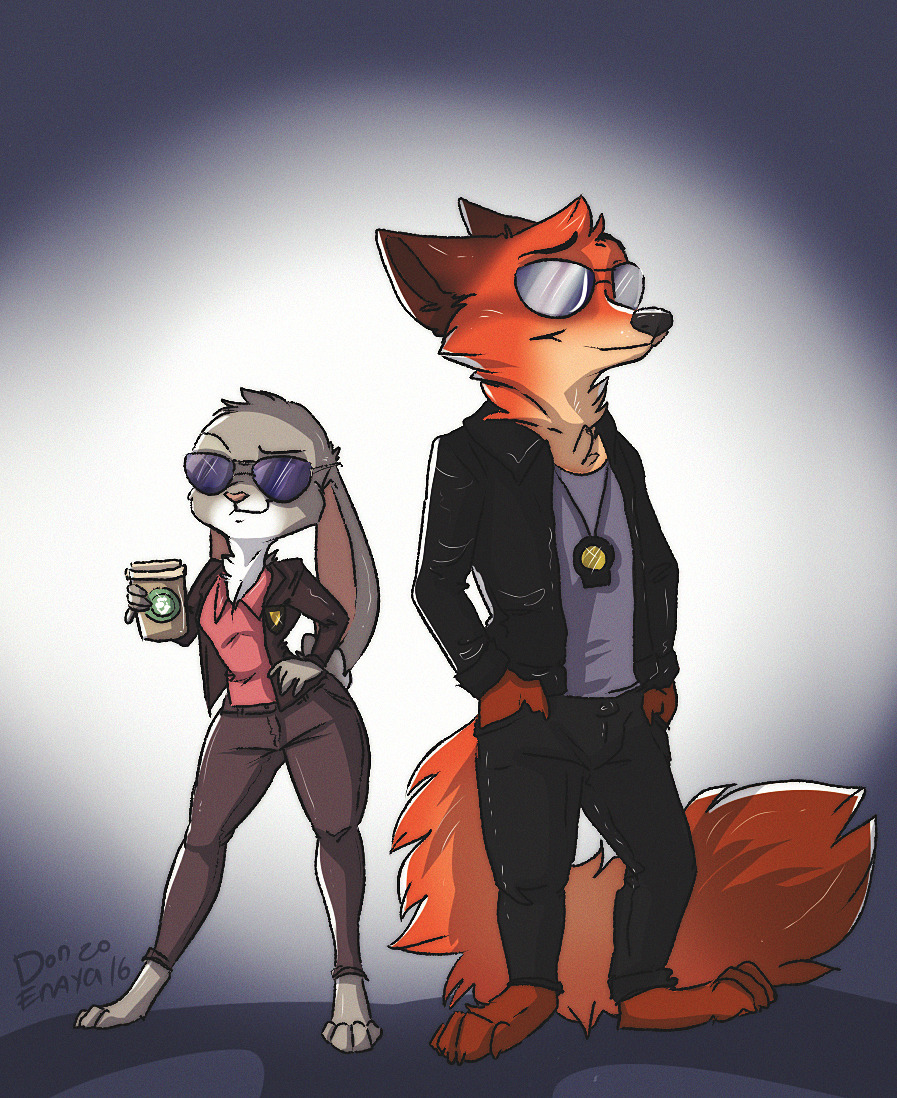
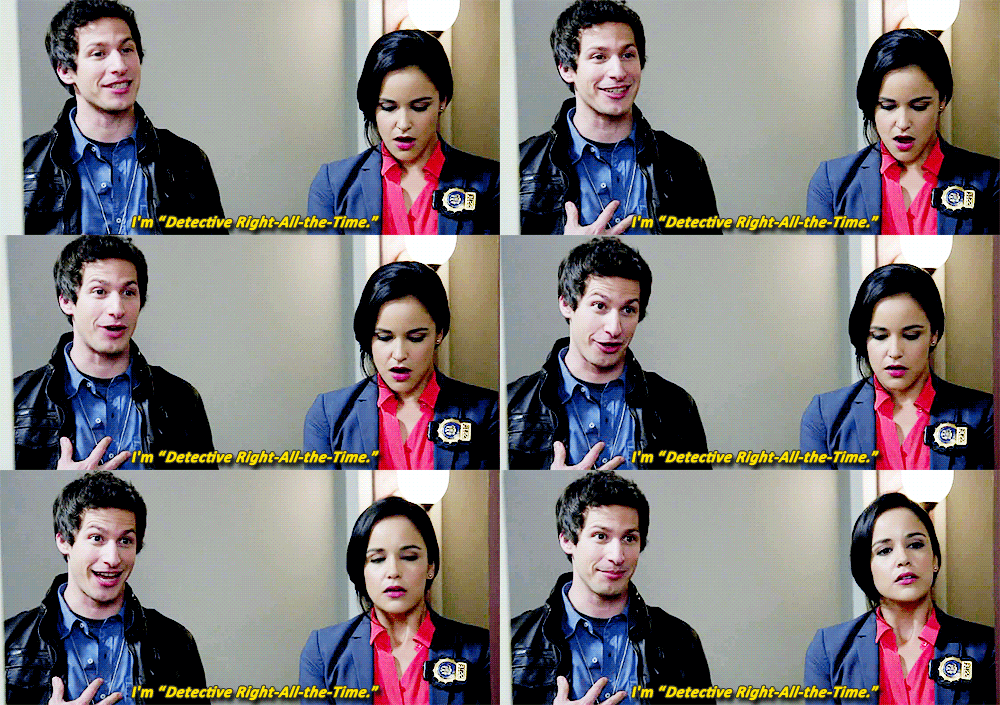
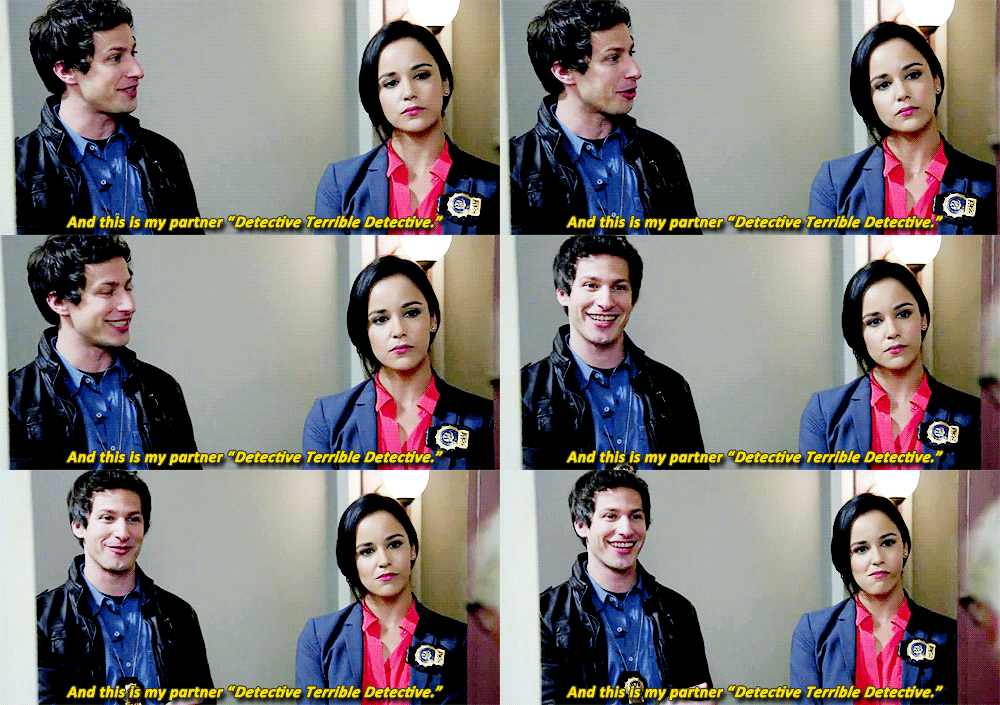
When I first watched Zootopia, Nick Wilde and Judy Hopps distinctively reminded me of Jake Peralta and Amy Santiago in Brooklyn Nine-Nine. As the illustration shows, I was not the only one who noticed. While Jake Peralta is the lead character of Brooklyn Nine-Nine, Amy Santiago is an equally strong character in the main cast. The two characters are amicable coworkers who often clash with one another, in an eerily similar way that Nick and Judy struggled in the first act of the movie.


Like Judy Hopps, Amy Santiago is a competitive young woman who is determined to prove how tough she is. She is also quite a stickler for the rules and often has to call out Jake whenever he is less-than-professional in his ways. While Jake and the rest of the Nine-Nine detective squad do respect her and take her seriously, they don't miss the chance to tease her, often insinuating that she is childish or old-fashioned or even unskilled. While she is good at her job, Jake manages to be a quicker thinker than she is, with less effort.

Like Nick Wilde, Jake Peralta is witty, snarky, and has a big heart under a flippant attitude. While Jake has had a tough childhood, it had more to do with having a broken family than any sort of bullying. He also clashes with his superior Captain Raymond Holt but comes to respect him more as the series progresses; not unlike Nick's burgeoning relationship with Chief Bogo.

But that is where the similarities end. In a way, Judy Hopps has a bit of Jake Peralta in her, too. While Jake is openly rebellious toward his strict boss, Captain Holt, because he prefers go off on his own path where he thinks his own way of solving crimes is more efficient, Judy goes against regulations because of a misplaced sense of righteousness. With Judy being Nick's superior by the end of the movie, we don't exactly see how Nick performs on his new job as a cop.

But what's beautiful about Zootopia is that it maintains an element of mystery regarding its two leads. We see nothing of Judy in the fifteen years between Gideon Grey's attack and training at the Zootopia Police Academy. All we know about Nick is that a traumatic event at age 9 destroyed his optimism while a combination of poverty and discrimination had him running marginally legitimate and ethically questionable hustles every day for 20 years from the age of 12. The rest of the movie spans two days, a montage that spans three months, and an indeterminate time skip between the climax and the epilogue. The narrative is chiefly plot-oriented, leaving plenty of room for interpretation for the characters involved. It also helps that the narrative acknowledges that personalities are multifaceted; nobody is fully good or evil, and that even some biases are justifiable.

Much of the ambiguous elements of the movie are intentional, and cleverly so. While there are a myriad of interpretations of the characters through Zootopia fan fiction, the interpretation for Nick and Judy is surprisingly consistent. Apparently, fans regard Judy as the "more mature" half of the pair while Nick doesn't really take anything seriously. While this can (and has been) done pretty well in the many pieces of fan fiction I've read, something about the idea feels a little off, to me.

Nick is usually written as a slob who is good at his job but otherwise favors fun over work to the point of being lazy sometimes, which is problematic to me. You don't make "200 bucks a say, 365 days a year" for 20 years by being lazy. I don't imagine Nick being dependent on Judy for anything. I don't think his ego could handle that. Furthermore, I think having a legitimate career would be so fulfilling for him that he would be dedicated to it, so he could keep it and his Carrots.

The "lazy, immature Nick" idea is usually lifted from a set of concept art by digital artist Armand Serrano including the pitiful state of Nick's apartment, which is a leaky basement in a building in the Rainforest District. We never see this apartment in the movie, but fans accept it as canon anyway. But I for one don't see his living quarters' dingy condition as an indication of laziness. With that many pipes shooting out from every which way and leaking onto the floor and through the walls all the time, I don't see how it is possible for him to keep his living space tidy anyway. It's a legitimate idea, but it's also an iffy one.

Despite being decidedly more serious than Nick, Judy has displayed some degree of childishness throughout the movie, especially in the first act. She risks breaking police protocol and disregards her status as the rookie of her precinct. Her class valedictorian status shoots up her ego to the point that she feels entitled to make demands instead of keeping her head down like any other newbie in any career track. In the third act, she lets her ignorance and naïveté get the best of her, hurting Nick in the process. Sure, she seems to have adulthood figured out, but her shortcomings are something people out to remember sometimes, when they attempt to interpret her. Seriousness doesn't necessarily equate maturity.

In romantic narratives, Nick's perceived immaturity is often interpreted as being emotionally stunted. Having made a conscious decision as a little kit onwards to build a barrier of humor around himself, Nick is interpreted that having closed off his emotions to everyone else has made it difficult for him to address his own emotions to himself. In many of the narratives, Judy--in typical romantic comedy lead fashion--would have to pry him out of his shell while he struggles to say "I love you" to her even know he knows it painfully well. Again, this makes for some rich drama, but it comes off cliché and amateurish in less than skilled hands.

They might be borrowing a little too much Jake Peralta elements in interpreting Nick. Whereas Jake is genuinely confident and his Class Clown persona is drawn from being immature (and Daddy Issues), it's mostly a mask, a defense mechanism for Nick. Nick is more intelligent and mature than he seems at first glance. His contributions to Judy's investigation in the movie indicates that he is a sharp thinker and likely more introspective as well. Few fan fiction writers have written Nick as having figured out his feelings for Judy; hence, dropping the L-bomb at the end of the movie.

Contrary to Jake Peralta being "uncomfortable with emotions" (yes, he says that at one point), I see Nick Wilde to be quite in touch with his emotions. The fact that he chooses to conceal them to others may or may not be the same as being "emotionally stunted." It is understood among both the writers of the film and the film's fans that humor is a psychological defense mechanism for Nick, but considering the complexity of his character, it's entirely possible that keeping a mask on does not necessarily equate having a case of emotions he can't unlock on his own. As far as I see it, Nick's humor tends to match whatever he's feeling at the moment. He is passive-aggressive when he is annoyed; he goes off on tirade laced with offensive slang when he is especially ruffled; and he teases others when he is happy. He becomes transparent, however, when he is scared, angry, or contemplative. In other words, he is in control. And if telling his backstory to Judy in the Rainforest District is of any indication, he seems to have no problem opening up to someone once he is close to them.

So what's with the recurring drama of Nick being reluctant to just tell Judy he loves her? Wasn't he the one who dropped the L-word at the end of the movie? Granted, neither of them says it outright, but Nick saying, "You know you love me," sounds like a straight "I love you" is in the near future.

It deeply bothers me that many fans of the film regard Nick and Judy as opposites when they're not. They have similar ideals, and when it comes to both smarts and strength, I like to think they're more or less the same as well. They just have a slightly different temperament. Nick and Judy interact similarly to Jake and Amy respectively, but the analogy isn't exact. While I am also inclined to think that Nick isn't as obsessed with becoming a police officer as Judy, he doesn't come off as someone who would skimp on paperwork or come to work late, which are common Officer Nick Wilde traits in fan fiction. If he would be dedicated enough to sell enough Pawpsicles or fur rugs to make $200 a day, every day for 20 years, he certainly could show as much dedication to being a police officer. If this is the case, Judy would have no need to nag him about anything. After all, they've been on the same page since surviving Manchas' attack.

Friday, August 12, 2016

I Just Have a Lot of Feelings; or, On Shipping Nick Wilde and Judy Hopps


I once told myself I wasn't going to watch Zootopia. After the colossal disasters Maleficent and Cinderella, I didn't have much faith in Disney anymore. But after seeing Zootopia's impressive Certified Fresh rating on Rotten Tomatoes and a gentle nudge by a close friend, I decided to see for myself what was good about this revival of Disney's tradition of anthropomorphic animal characters. Well, needless to say, I was hooked. Zootopia is an incredibly intelligent film, a modern fable about racism and prejudice.

Beyond that, it is something of a love story. Seemingly following Frozen's tradition of rejecting romantic love as the only standard of love, Zootopia presents the unlikely friendship of a fox con artist and a rabbit cop. Nick Wilde and Judy Hopps are such strong characters with great chemistry together that fans such as myself cannot resist imagining them as a couple. For weeks since I first saw the film (and I have now watched it more times in the three weeks than I watched Frozen in three years), I indulged myself with plenty of Zootopia fan fiction. I am proud to say that the Zootopia fandom have such talented and intelligent people writing stories I can barely come up with. Many stories further explore the themes of the film. Some present the excitement and danger of police work. And most of these stories use the movie's political themes as a backdrop for the romance of Nick and Judy. It's all incredibly fun to read. However, I have noticed a few patterns that are problematic to me.

A common Fanon dynamic between Nick and Judy is that, being the younger half of the two, Judy tends to be portrayed as the oblivious ingenue. If this trope is active, Nick would be friendzoned until he either makes an Anguished Declaration Of Love or Judy somehow learns that her affection for him is deeper than friendship. And when they do hook up, they get excited about the relationship like teenagers.

Now, I appreciate these writers and their imagination, but I think it goes against the organic development of the two characters' relationship. Their love, regardless of whether it is philia (Platonic love) or eros (romantic love), is based on mutual respect and trust because they overcame their differences and their prejudice against one another. Regardless of what kind of love it is, it is love nonetheless. Their mutual affection is no secret to either of them, so there is little to no need for a big reveal that they love each other. If love has been there all along, it just has to grow into something more, slowly, not suddenly.

Furthermore, these are two adult characters, not teenagers. Judy is 24, and Nick is about 32, possibly the oldest leads in the Disney Animated Canon. I think it's safe to say that they would respond to any ensuing romance differently from our adolescent Disney Princesses. Either they remain friends or make a mutual decision to take their relationship to the next level, whatever that might entail. I imagine the only real drama would be the outside forces that might be working against them.

Tuesday, September 16, 2014

Upcoming Fanfiction.net Project

I am currently writing a short and fast-paced fanfic based on the Underworld movies. I have enjoyed the vampires versus werewolves saga since the first movie came out in 2003. This was the same year Evanescence's pseudo-gothic image was all the rage and I was one of their angst-ridden teen fans that followed the raven-haired frontwoman to the franchise's fandom.

Now that I am older and more critical of anything in pop culture, I have noticed that while Underworld remains to be a halfway effective narrative of how love conquers all, the plot, especially that of the first movie, is flawed and muddled. The marketing was misleading. The only reason the franchise is so successful is the generous amount of sex and violence in the films.
Girl with Guns makes effective Freudian imagery in film, too.
Its conventional portrayal of vampires and werewolves also became a breath of fresh air as the release of the sequels coincided with the Twilight films.
Yeah..
But in my most recent viewing of the first Underworld film, I realized that the plot was contrived and complicated. Why doesn't anybody believe Selene when she established herself to be a dedicated (albeit obsessive) Death Dealer? What is Kraven's motivation to keep Lucian's presence a secret when Lucian's whole mission is to destroy vampires? Why doesn't anybody join Selene in her investigation that Kraven is conspiring with Lucian? Since she turned out to be correct even with little evidence, couldn't the narrative have gone a little quicker? More importantly: Why are Selene and Michael in love? And how is the Romeo and Juliet concept supposed to work when Michael is a neutral party and victim of circumstances the whole time?

Underworld creator Kevin Grevioux (werewolf Raze in the first and third movies) came up with the concept after a romantic relationship with a white woman, which was met with disapproval from both his and his girlfriend's loved ones. So why not have Raze be Selene's lover instead of Michael? Raze has been Lucian's second-in-command for centuries and Selene has been a ruthless Death Dealer for centuries. Wouldn't it be more interesting and compelling if an unlikely alliance between them blossoms into a forbidden love affair they have to fight for? I think the fact that Raze is a black man drives the point further.

Read my fics and watch out for new ones here: https://www.fanfiction.net/~aeshnalacrymosa

Friday, October 14, 2011

What Would Edward Do?


I remember telling myself that I would finally stop ranting about Twilight. For a while, I have ceased talking about it, although I have entertained hateful thoughts about it from time to time. Also after finally reading all four books and the spinoff novella in PDF and the first three movies, I have also decided that the Twilight series is not worth the attention it is getting. When it comes to the hatedom, however, I believe that it is necessary to promote understanding as to why Twilight is what I and countless others like me think it is.

Perhaps what contributed to my recent silence toward the series is that I have been busy writing a couple of pieces of fan fiction set seven years after the series finale, with my favorite character, Leah Clearwater in the lead. Time and again, I have expressed through my stories my own interpretation of the characters particularly those I dislike, like Bella Swan, Edward Cullen and Sam Uley. Hell, I have even criticized otherwise likeable Dr. Carlisle Cullen, blaming him along with Bella for any unnecessary and pointless conflict in the series and their tragic outcomes. I am referring in particular to the death of poor Bree Tanner, who was executed by the Volturi just for being involved; she hasn’t done anything, not even stepping foot into the actual battlefield. I am also talking about the dozens of innocent people who were either turned into vampires and then killed or killed by these vampires as their meal.

Anybody who has read Twilight or the movie adaptations tend to blame Victoria for the unnecessary tragedy. But I blame Bella nonetheless. If she hadn’t been there on that fateful baseball game, James wouldn’t have run after her; Edward wouldn’t have killed him, driving Victoria on a vengeful rampage. I would even say that Victoria was a brave woman to have gone through the trouble of risking tipping off the Volturi just to kill one puny human with unnecessary protection, but that’s for another essay.

What concerns me now is an entirely different matter. Last year, I wrote a blog entry bemoaning the lack of appropriate conclusion for Leah Clearwater. I wrote a piece of fan fiction to appease my grief over the injustice of it all. Then, to see if the happy ending does not falter, I wrote a sequel set eight years after the ending of the first one; I suggest you read it here before you continue reading.

The plot concluded the way I wanted and the way it would naturally flow according to the circumstances. So far, I’ve only had two reviews. One is pleased with the ending, and another is not. The latter said: “Was a asome plot and story up till the last chapter. I hated it not that Im a bella and Edward lover but It really was off of character that stephine meyers made them to be. yeah Edward is real pain when it comes to protecting his family but I don't think he would be that way. Like Said great story up to last chapter.”

If you have read the story, you would see that I somehow made all characters as close to the canon as possible. But as a fan fiction writer, I believe it is also my duty to incorporate some of my interpretation into the story and into the characters. If you would check the author’s profile page, I made it clear that I am not a fan of Twilight, and I don’t share the fans’views about it. However, my general opinion of the books is mostly irrelevant here; the matter on hand is the character of Edward Cullen.

Edward has always struck me as an arrogant, devious and intrusive stalker who resorts to deceit and emotional manipulation to get what he wants. I think that, even in his few moments of genuine affection, he gets carried away by his own emotions because of his stunted maturity. He has no reason to love Bella, much less a reason to hate Jacob or his wolf-brothers (and sister). And even if I believe he does, Edward doesn’t give me a reason to care. The primary reason I don’t care for anything he thinks or says or does is because I blame him and Bella (and to a lesser extent, Carlisle Cullen) for anything that ever happens in the series; in fact, I root for Victoria for wanting to kill the little bone-bag and going through the trouble of making a newborn army just to kill someone who doesn’t deserve my sympathy.

If a heartbroken vampire is an unstoppable destructive force, isn’t Victoria only acting upon her own instinct and emotion suitable to that of a true vampire? And James, he wouldn’t have died if Bella wasn’t even in the secret baseball field with the damn Cullen family!

Okay, let’s think of it this way: if Bella did die, wouldn’t Edward be pissed and go on a quest to kill Victoria? If he is the protagonist, you would have rooted for him, right? Well, the same thing happened to Victoria; why would you still root for Edward and not her? What is it about Bella that she is so important?—that she is his “true love”? WHY is she his true love? That’s what I don’t understand! And I don’t need anybody to tell me to understand anymore. I’ve read all four books and the pointless spinoff novella. I’ve seen the three movies, and I am willing to see the next two. The series is ending, and nothing is there that could show me why I should care that Edward and Bella should be together.

In fact, I don’t think they deserve a happy ending. Leah Clearwater does because her life sucks, and she doesn’t deserve to feel hurt. Feel free to read my blog entry here to see why.

Now, as I have stated, Edward is a selfish, overbearing jerk with no contribution to society and therefore does not deserve to exist. Okay, maybe that was a little harsh. There are many other characters—well-written characters of any given alignment—that have little or no contribution to their society. And that’s barely even the problem; my issue with Edward is that he doesn’t have a reason for me to care about him. His fangirls might try, but so far, anything important or ‘good’ I’ve heard about him are the shallow stuff: that he’s affectionate, “protective” and “devoted” to the point of being annoying but it’s okay because he’s hot and his heart is in the right place so he practically can do no wrong.

Except that he does get carried away by his passionate and fiery temperance and even those who love him (fellow characters or real-world fangirls) admit that he does make silly decisions or thoughts. So now we get to my final point: why would he then not act the way he did in the climax of “Wolf People II”? Based on his fans’ interpretation on him, how else would he have handled the fear that the only other supernatural beings closely allied to his family is keeping a secret that one of them is married to what they all consider a true monster? Why would the fans “not think he would be that way”? Under the given conflict and circumstances, what would he have done based on the intended character structure Stephenie Meyer intended him to be?

Okay, maybe dragging a man by his hair to his wife’s feet was a tad cruel coming from Edward Cullen. But think about this: openly insulting the second closest man to his significant other’s heart is not that much of a stretch. If he can repeatedly call Jacob Black with derogatory terms instead of his proper name, how much crueler can Edward Cullen possibly be to someone he has identified as an enemy? For goodness sake, he tore off a heartbroken woman’s head because he killed her mate! He didn’t bother to see Leah’s point of view when she berated Bella and made her cry; he was arrogant enough to claim he knows what Bella is feeling but Leah’s mind is an open book to him, and he doesn’t understand why she’s angry with Bella for breaking Jacob’s heart. If Leah wasn’t remotely important to Jacob, Edward might have killed her if you ask me. So what’s to stop him from wanting to kill Nanuq?

What else could he have reasonably done? Come on, my Twilighter friends. Enlighten me.