Showing posts with label Disney. Show all posts

Sunday, November 6, 2016

[Zootopia SPOILERS] Interpreting Nick and Judy for Fan Fiction; or, the Question of Who Is More Mature

"Smort!"
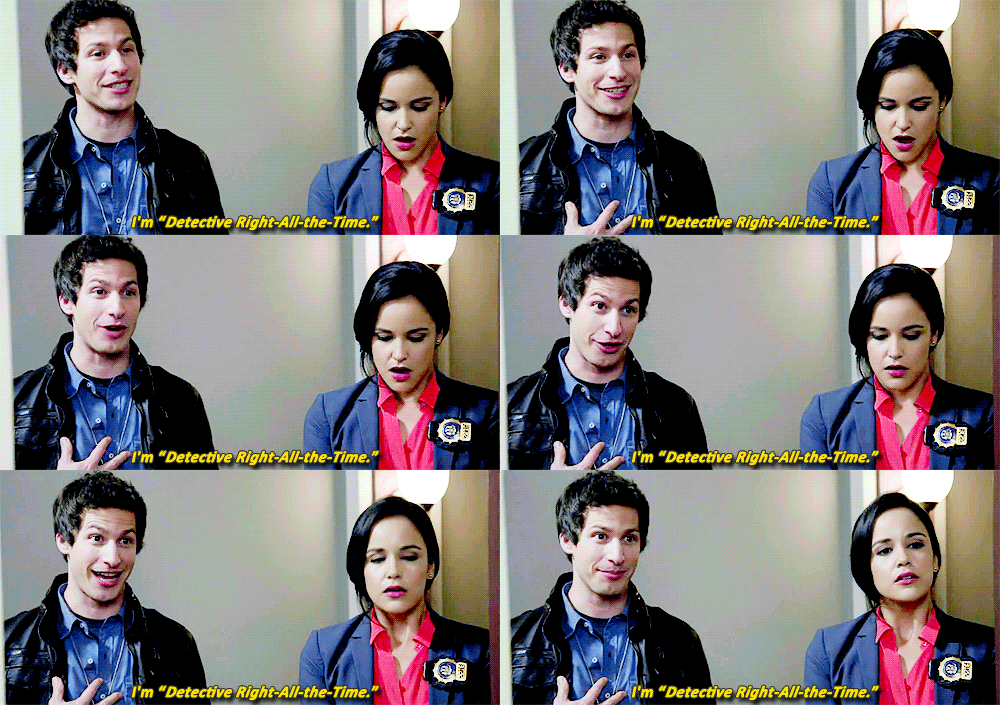
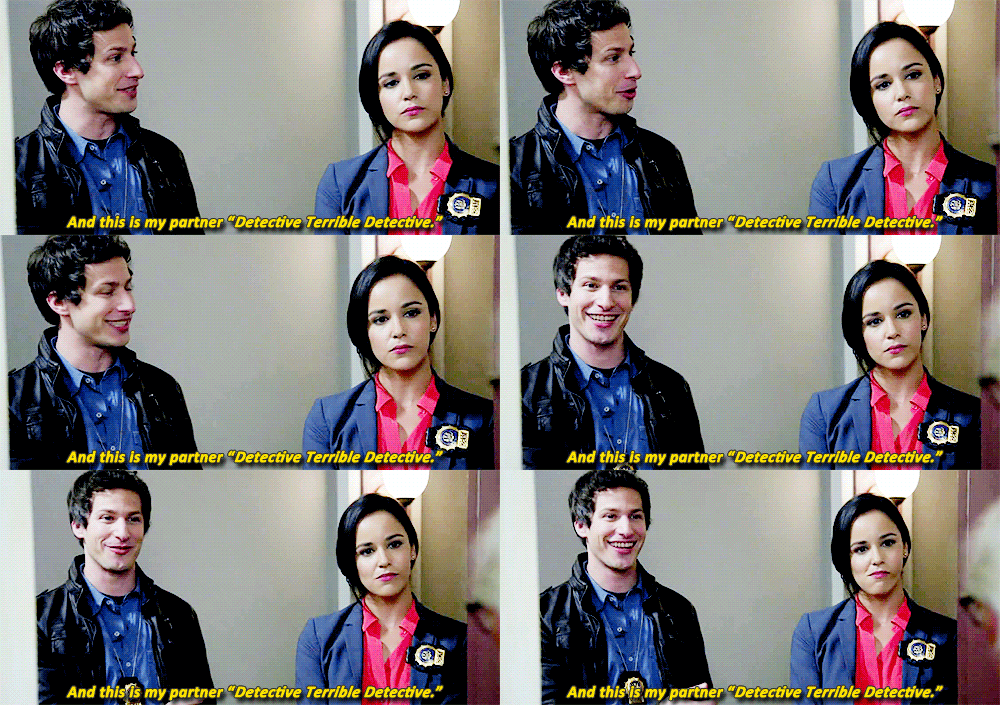
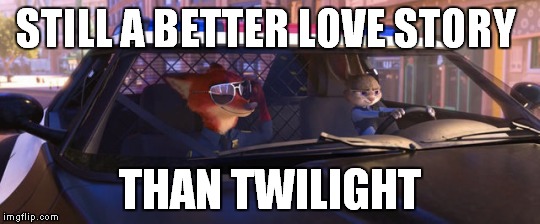
When I first watched Zootopia, Nick Wilde and Judy Hopps distinctively reminded me of Jake Peralta and Amy Santiago in Brooklyn Nine-Nine. As the illustration shows, I was not the only one who noticed. While Jake Peralta is the lead character of Brooklyn Nine-Nine, Amy Santiago is an equally strong character in the main cast. The two characters are amicable coworkers who often clash with one another, in an eerily similar way that Nick and Judy struggled in the first act of the movie.


Like Judy Hopps, Amy Santiago is a competitive young woman who is determined to prove how tough she is. She is also quite a stickler for the rules and often has to call out Jake whenever he is less-than-professional in his ways. While Jake and the rest of the Nine-Nine detective squad do respect her and take her seriously, they don't miss the chance to tease her, often insinuating that she is childish or old-fashioned or even unskilled. While she is good at her job, Jake manages to be a quicker thinker than she is, with less effort.

Like Nick Wilde, Jake Peralta is witty, snarky, and has a big heart under a flippant attitude. While Jake has had a tough childhood, it had more to do with having a broken family than any sort of bullying. He also clashes with his superior Captain Raymond Holt but comes to respect him more as the series progresses; not unlike Nick's burgeoning relationship with Chief Bogo.

But that is where the similarities end. In a way, Judy Hopps has a bit of Jake Peralta in her, too. While Jake is openly rebellious toward his strict boss, Captain Holt, because he prefers go off on his own path where he thinks his own way of solving crimes is more efficient, Judy goes against regulations because of a misplaced sense of righteousness. With Judy being Nick's superior by the end of the movie, we don't exactly see how Nick performs on his new job as a cop.

But what's beautiful about Zootopia is that it maintains an element of mystery regarding its two leads. We see nothing of Judy in the fifteen years between Gideon Grey's attack and training at the Zootopia Police Academy. All we know about Nick is that a traumatic event at age 9 destroyed his optimism while a combination of poverty and discrimination had him running marginally legitimate and ethically questionable hustles every day for 20 years from the age of 12. The rest of the movie spans two days, a montage that spans three months, and an indeterminate time skip between the climax and the epilogue. The narrative is chiefly plot-oriented, leaving plenty of room for interpretation for the characters involved. It also helps that the narrative acknowledges that personalities are multifaceted; nobody is fully good or evil, and that even some biases are justifiable.

Much of the ambiguous elements of the movie are intentional, and cleverly so. While there are a myriad of interpretations of the characters through Zootopia fan fiction, the interpretation for Nick and Judy is surprisingly consistent. Apparently, fans regard Judy as the "more mature" half of the pair while Nick doesn't really take anything seriously. While this can (and has been) done pretty well in the many pieces of fan fiction I've read, something about the idea feels a little off, to me.

Nick is usually written as a slob who is good at his job but otherwise favors fun over work to the point of being lazy sometimes, which is problematic to me. You don't make "200 bucks a say, 365 days a year" for 20 years by being lazy. I don't imagine Nick being dependent on Judy for anything. I don't think his ego could handle that. Furthermore, I think having a legitimate career would be so fulfilling for him that he would be dedicated to it, so he could keep it and his Carrots.

The "lazy, immature Nick" idea is usually lifted from a set of concept art by digital artist Armand Serrano including the pitiful state of Nick's apartment, which is a leaky basement in a building in the Rainforest District. We never see this apartment in the movie, but fans accept it as canon anyway. But I for one don't see his living quarters' dingy condition as an indication of laziness. With that many pipes shooting out from every which way and leaking onto the floor and through the walls all the time, I don't see how it is possible for him to keep his living space tidy anyway. It's a legitimate idea, but it's also an iffy one.

Despite being decidedly more serious than Nick, Judy has displayed some degree of childishness throughout the movie, especially in the first act. She risks breaking police protocol and disregards her status as the rookie of her precinct. Her class valedictorian status shoots up her ego to the point that she feels entitled to make demands instead of keeping her head down like any other newbie in any career track. In the third act, she lets her ignorance and naïveté get the best of her, hurting Nick in the process. Sure, she seems to have adulthood figured out, but her shortcomings are something people out to remember sometimes, when they attempt to interpret her. Seriousness doesn't necessarily equate maturity.

In romantic narratives, Nick's perceived immaturity is often interpreted as being emotionally stunted. Having made a conscious decision as a little kit onwards to build a barrier of humor around himself, Nick is interpreted that having closed off his emotions to everyone else has made it difficult for him to address his own emotions to himself. In many of the narratives, Judy--in typical romantic comedy lead fashion--would have to pry him out of his shell while he struggles to say "I love you" to her even know he knows it painfully well. Again, this makes for some rich drama, but it comes off cliché and amateurish in less than skilled hands.

They might be borrowing a little too much Jake Peralta elements in interpreting Nick. Whereas Jake is genuinely confident and his Class Clown persona is drawn from being immature (and Daddy Issues), it's mostly a mask, a defense mechanism for Nick. Nick is more intelligent and mature than he seems at first glance. His contributions to Judy's investigation in the movie indicates that he is a sharp thinker and likely more introspective as well. Few fan fiction writers have written Nick as having figured out his feelings for Judy; hence, dropping the L-bomb at the end of the movie.

Contrary to Jake Peralta being "uncomfortable with emotions" (yes, he says that at one point), I see Nick Wilde to be quite in touch with his emotions. The fact that he chooses to conceal them to others may or may not be the same as being "emotionally stunted." It is understood among both the writers of the film and the film's fans that humor is a psychological defense mechanism for Nick, but considering the complexity of his character, it's entirely possible that keeping a mask on does not necessarily equate having a case of emotions he can't unlock on his own. As far as I see it, Nick's humor tends to match whatever he's feeling at the moment. He is passive-aggressive when he is annoyed; he goes off on tirade laced with offensive slang when he is especially ruffled; and he teases others when he is happy. He becomes transparent, however, when he is scared, angry, or contemplative. In other words, he is in control. And if telling his backstory to Judy in the Rainforest District is of any indication, he seems to have no problem opening up to someone once he is close to them.

So what's with the recurring drama of Nick being reluctant to just tell Judy he loves her? Wasn't he the one who dropped the L-word at the end of the movie? Granted, neither of them says it outright, but Nick saying, "You know you love me," sounds like a straight "I love you" is in the near future.

It deeply bothers me that many fans of the film regard Nick and Judy as opposites when they're not. They have similar ideals, and when it comes to both smarts and strength, I like to think they're more or less the same as well. They just have a slightly different temperament. Nick and Judy interact similarly to Jake and Amy respectively, but the analogy isn't exact. While I am also inclined to think that Nick isn't as obsessed with becoming a police officer as Judy, he doesn't come off as someone who would skimp on paperwork or come to work late, which are common Officer Nick Wilde traits in fan fiction. If he would be dedicated enough to sell enough Pawpsicles or fur rugs to make $200 a day, every day for 20 years, he certainly could show as much dedication to being a police officer. If this is the case, Judy would have no need to nag him about anything. After all, they've been on the same page since surviving Manchas' attack.

Friday, August 12, 2016

I Just Have a Lot of Feelings; or, On Shipping Nick Wilde and Judy Hopps


I once told myself I wasn't going to watch Zootopia. After the colossal disasters Maleficent and Cinderella, I didn't have much faith in Disney anymore. But after seeing Zootopia's impressive Certified Fresh rating on Rotten Tomatoes and a gentle nudge by a close friend, I decided to see for myself what was good about this revival of Disney's tradition of anthropomorphic animal characters. Well, needless to say, I was hooked. Zootopia is an incredibly intelligent film, a modern fable about racism and prejudice.

Beyond that, it is something of a love story. Seemingly following Frozen's tradition of rejecting romantic love as the only standard of love, Zootopia presents the unlikely friendship of a fox con artist and a rabbit cop. Nick Wilde and Judy Hopps are such strong characters with great chemistry together that fans such as myself cannot resist imagining them as a couple. For weeks since I first saw the film (and I have now watched it more times in the three weeks than I watched Frozen in three years), I indulged myself with plenty of Zootopia fan fiction. I am proud to say that the Zootopia fandom have such talented and intelligent people writing stories I can barely come up with. Many stories further explore the themes of the film. Some present the excitement and danger of police work. And most of these stories use the movie's political themes as a backdrop for the romance of Nick and Judy. It's all incredibly fun to read. However, I have noticed a few patterns that are problematic to me.

A common Fanon dynamic between Nick and Judy is that, being the younger half of the two, Judy tends to be portrayed as the oblivious ingenue. If this trope is active, Nick would be friendzoned until he either makes an Anguished Declaration Of Love or Judy somehow learns that her affection for him is deeper than friendship. And when they do hook up, they get excited about the relationship like teenagers.

Now, I appreciate these writers and their imagination, but I think it goes against the organic development of the two characters' relationship. Their love, regardless of whether it is philia (Platonic love) or eros (romantic love), is based on mutual respect and trust because they overcame their differences and their prejudice against one another. Regardless of what kind of love it is, it is love nonetheless. Their mutual affection is no secret to either of them, so there is little to no need for a big reveal that they love each other. If love has been there all along, it just has to grow into something more, slowly, not suddenly.

Furthermore, these are two adult characters, not teenagers. Judy is 24, and Nick is about 32, possibly the oldest leads in the Disney Animated Canon. I think it's safe to say that they would respond to any ensuing romance differently from our adolescent Disney Princesses. Either they remain friends or make a mutual decision to take their relationship to the next level, whatever that might entail. I imagine the only real drama would be the outside forces that might be working against them.

Monday, June 9, 2014

In-Depth Review of Maleficent [SPOILERS and RAEG Ahead]

I'm sure anyone like me who has seen Walt Disney's 1959 adaptation of Sleeping Beauty was excited to see Maleficent since seeing the goosebumps-inducing teaser featuring Angelina. Jolie.


For all the kids who might be too young to grasp the significance of this actress, Angelina Jolie is an extremely talented performer and a devoted philanthropist with six children, three of whom are adopted from Cambodia, Ethiopia, and Vietnam. (The other three are biological children from fellow acclaimed actor Brad Pitt.) She has a long and illustrious movie career and is most famous for the following movies:

  1. Gia (1998 HBO Original biographical film)

 2. Girl, Interrupted (1999 adaptation of memoir of the same name)

3. Lara Croft: Tomb Raider (2001 video game adaptation)


Since breaking into the spotlight with these three movies, she has become an A-list celebrity with a string of both action and drama films. The rawness of her performances makes her an ideal choice for one of Disney's most iconic villains.


Maleficent gets roughly 15 minutes of screen time in Sleeping Beauty. As with many classic Disney Villains of the time, there is really nothing we need to know about her except that she is evil. She is so evil that she is willing to kill a baby simply because her parents didn't invite her to the presentation of the infant princess. She is offended at not having received an invitation whereas the Three Good Fairies Flora, Fauna, and Merryweather were invited and were allowed to bestow gifts upon the child. If that's not enough, her very name means "evil." As the villain of the story, the audience only has to wait and see how she is inevitably defeated.

There was really nothing else to it, and much of her background is only hinted at in the dialog. As in the original fairy tale, Maleficent is a fairy; however, in accordance to her name and character design, she is an evil fairy with purely destructive powers. The gentlest fairy Fauna is willing to believe that Maleficent can be reasoned with because "she can't be all bad." But the cleverest fairy Flora tells her with utmost certainly that Maleficent indeed can be all bad. However, when she suggests to "turn [Aurora] into a flower [because] a flower can't prick its finger," the shrewdest fairy Merryweather points out that Maleficent can only easily "send a frost" the same way that she, according to Fauna, "has always ruined [Flora's] nicest flowers." This can explain the outward hatred that the Three Good Fairies show toward Maleficent when the latter appears uninvited to King Stefan's court. Merryweather even goes so far as to call Maleficent a "wicked witch."

It also appears that the hatred is mutual. She openly insults the Three Good Fairies at the presentation by calling them "the rabble," a term meaning, "the lowest class of people."

When Merryweather says that they cannot easily hide Aurora because "Maleficent knows everything," Fauna points out that "Maleficent doesn't know anything about love, or kindness, or the joy of helping others." This is perhaps the greatest form of evil: one that cannot comprehend good or its components. Destruction and malice is all Maleficent can do, so these are also all she knows. It is perhaps for this reason that she lives technically in solitude in the Forbidden Mountain where other fairies are not allowed to visit. In the Forbidden Mountain, Maleficent resides in a decrepit castle where mostly only the dungeons and a few towers are intact. One can imagine that either that the fairies exiled her into her ominous domain or that she separated herself from the other fairies and enjoyed her solitude with her raven as her only friend.

Maleficent turned out to be disheartening for me to watch because I love Maleficent because she's bad to the bone. I love her as a villain because this makes her a force to be reckoned with. This makes the Three Good Fairies work very hard to avert the curse and, when that failed, to defeat her for good.

That's what I wanted to see in Maleficent: besides an account of the run-of-the-mill "how she became evil" narrative in the tradition of Wicked, I expected to see an account of how her destructive powers and malicious ways brought her to the Forbidden Mountain and how she assembled a band of grotesque goblins to do her bidding. This would have been a helpful PG guide for antisocial personality disorder, a frightening real-life psychological disorder in which a patient literally has no conscience and performs harm and destruction for no reason in particular. Patients with antisocial personality disorder are more commonly known as sociopaths or psychopaths. Maleficent is one such character.

Instead, Disney presents us with a saccharine yet cynical narrative of how Maleficent turned evil and, really, isn't evil at all. The whole film and the character it runs with are both victims of incredibly lazy writing. It seemed to me that Disney was like, "Here is Angelina Jolie. We know you all like her, so we won't bother with anything else because you will all pay to see her anyway." This is insulting. While I admire Angelina Jolie very much, Disney was wrong to assume that all of the audience come to the theater just to see Angelina Jolie; no, I came to see Maleficent, the Mistress of All Evil.

Maleficent begins not in the Forbidden Mountain but in what the narrator simply calls The Moors. This was a very interesting start as the Moors is clearly inspired from Fern Gully, a flourishing wetland where magical creatures dwell. Maleficent is introduced as a fairy with kob horns and large hawk's wings with a single talon on each of them. Like the elves in Fern Gully, Maleficent is a force of nature that can grow and heal plants. I was willing to go along with this at first, but I quickly knew that this movie will not be as I expected.

The young fairy Maleficent is established to be proud but compassionate. Her greatest minions are mossy tree creatures with the same silhouette as Chernobog from the Night on Bald Mountain sequence of Fantasia. Because of her strong wings and level head, she becomes the protector of the Moors. In her childhood, she meets the wandering urchin Stefan, with jet black hair, a pale olive skin, and a hard face with a pointed nose. The two become friends and, in adolescence, fall in love.

However, after Maleficent's sixteenth birthday, Stefan leaves the area to pursue success in society as a knight. The king, who is old and has no heirs to succeed him, appoints Stefan to be the new king after the latter, in a heartbreaking sequence, clips Maleficent's beautiful wings instead of beheading her as ordered. Forced to make do of what remains of her powers, Maleficent stops believing in true love and becomes a force of destruction. Creating a wall of thorns around the Moors, Maleficent rules the Moors as its evil queen and turns the Moors into a frosty wasteland where the inhabitants regard her with fear.

From here on out, the narrative diverges from its source material entirely. Maleficent neither resides in the Forbidden Mountain nor assembles an army of goblins. The fairies and other woodland creatures fear her but not oppose her. King Stefan is a lovable, steadfast, and somewhat quirky character from the animated classic but becomes a cruel warrior who is so blind with ambition that he is willing to betray his friend and lover to become king.

This reimagining of King Stefan is both good and bad. It's good because it fleshes out his character. Both his and Maleficent's character become more interesting because it entertains the idea that she cursed Aurora specifically because she has a grudge against him. It's bad because I can never look at this scene the same way again:


The Three Good Fairies are renamed and have dramatically different character designs and attributes.

Collectively known as The Pixies, Flittle, Thistlewit, and Knotgrass are annoying, incompetent, and unintelligent. Taking in Aurora was no longer their idea but King Stefan's, and they are shockingly neglectful guardians to the infant princess. They are not even remotely worried about her when she stays out of the cottage for days on end while spending time with Maleficent.

This is another way that Maleficent diverges from Sleeping Beauty. In the 1959 animated classic, Maleficent was unable to harm Aurora in her sixteen years with the Three Good Fairies because she has no idea where the girl is; in this retelling, Maleficent not only watches over the girl but even secretly cares for her when the Pixies don't. When the girl reaches adolescence, Aurora meets Maleficent and mistakenly identifies her as her Fairy Godmother. After a few days of bonding with her in the Moors, Aurora requests for Maleficent to let her live in the Moors with her. Maleficent acquiesces this request and even attempts to revoke her curse, only to find that the is unable to. Maleficent becomes visibly upset that she is unable to revoke the curse. She becomes even sadder when she points out that the countercurse is designed in a way that the curse can never be lifted: Aurora cannot be awakened by True Love's Kiss because there is no such thing as true love.

This is the part where I got downright disgusted. The Walt Disney Studios, which has instilled three generations worth of people with hope and love, has forgone both in favor of cynicism, which is apparently "cooler." It's one thing if Maleficent from Sleeping Beauty says it, because she's obviously the villain whom you are not supposed to root for; but here, it's Maleficent the designated heroine who says it. Is Disney now trying to teach kids that true love does not exist and so, by extension, the institution of marriage is a joke because a shockingly huge percentage of marriages end in divorce, like their parents'?

While I understand the intentions of this movie, it simply gets Sleeping Beauty all wrong. This movie makes it seem that Sleeping Beauty was an elaborate joke that, by the end, feels like a poor rehash of the ending of Ever After. In the end, Maleficent was a big corny mess and a pile of disappointment.

Sunday, June 1, 2014

Maleficent review [MINOR SPOILERS: Proceed with caution.]


As I predicted, Angelina Jolie was great as the title character. The movie worked a few angles that potential but it fell flat because the narrative decided to neglect a few key traits about the character and established narrative points in the original Sleeping Beauty movie:

1) While Maleficent WAS a fairy, it's established that she is an EVIL fairy who "doesn't know anything about love, or kindness, or the joy of helping others."

2) The Three Good Fairies show animosity toward Maleficent not only because she is evil but because she has destructive powers. It's hinted in the dialogue of the 1959 film that she frequently played tricks on the fairies and "She's always ruined [Flora's] nicest flowers" by "sending a frost."
3) It's hinted in the animated classic that Maleficent lives in the Forbidden Mountain BECAUSE she didn't belong with other fairies.
4) Hiding Aurora was the Fairies' idea; Maleficent had no idea where the girl was in all her 16 years.

5) The Fairies renamed their ward Briar Rose to effectively hide her from Maleficent.

Any good points in the movie left no real impression on the whole narrative. Pity. I was expecting she was more a Chaotic Neutral that went Chaotic Evil because of the fairies and not because of something else that the movie decided to go with instead.

Well, that's enough ranting for me tonight. Personally, I will not give Maleficent a second watch because, apparently, I have expectations. But if you're into the whole Wicked-style Story From the Other Side narrative, that's okay. But if you're bringing young children to the trailer, it's best you let them watch the 1959 animated classic first. https://www.youtube.com/watch?v=kCV0hy6ex1c

Saturday, February 15, 2014

In Defense of the Princesses (Part 2): The Fresh Batch

In recent years, Disney has received infamy for their inane Disney Channel sitcoms and original movies, and direct-to-video sequels. The Disney Channel has also given us a generation’s worth of tween stars, the most notable of whom have made their mark with varying degrees of controversy shortly after widespread popularity and success. Buxom redhead Lindsay Lohan is now a puffy-faced alcoholic who can’t hold down a job. Hilary Duff of Lizzie McGuire fame became anorexic in her late teens and have faded from the spotlight since recovering and subsequently becoming a mother. The stars of Camp Rock had a massive amount of haters for their uninspired brand of pop music. Demi Lovato battled eating disorders, drugs, and heartbreak that culminated into a suicide attempt. Vanessa Hudgens “accidentally” got a handful of nude pics leaked. And of course, Miley Cyrus.

It is clear that, somewhere along the way, the Disney Studios fell into the hands of greedy executives instead of passionate artists that gave us the classics. It appears that, after Mulan, Disney entered a dark period.
 VERY dark

The success of Pixar overtook the success of Disney’s traditionally animated features. What the Disney Animation Studios did not realize at the time was that Pixar’s success was not exclusive to its amazing CGI animation but with effective storytelling. What Pixar was really doing was use the technology they have to propel a story forward. The technology then becomes an efficient vehicle for a story, no matter how outlandish the concept. By the time The Incredibles became a smash hit and Treasure Planet became a huge flop, Disney decided to forgo traditional animation and dabble in CGI. They gave us Chicken Little.


It was clear at this point that the creative team at Disney had become so preoccupied with releasing several mediocre preteen-targeted TV movies and series that they had lost touch of what Disney was really about. It’s not about sugarcoated slogans about dreams and magic and wishing stars; it’s about preserving the purity in the human spirit. It’s this little spark of purity that yearns for justice and virtue—the same one that celebrates the triumph of good over evil. Isn’t that exactly what Disney succeeded with its most memorable classics? Isn’t that what Pixar achieved with precision in almost all of their works? No, Disney decided it was purely the CGI that made The Incredibles work while Treasure Planet flopped.

A dear friend of mine believes that this decline in quality is related to the power struggle between Nickelodeon and Disney. Nickelodeon rose to power because of their intoxicating slogan (“The TV channel FOR KIDS!”) and highly stimulating programs that conform to this slogan. While the Nickelodeon programs in the 90s were entertaining and memorable, many of them did not quite have the same lasting impact of the same intensity as Disney.

However, most of these programs tended to be more reflective of contemporary society rather than an illustration of idealism. Troublemakers who rebelled against authority are made heroes while the disciplined, straight-laced kids who put them in line are villains. (Recess and Even Stevens, anyone?) While these programs promoted independence and free thinking, most of them portrayed tenets of child culture that its audience will eventually grow out of and that are ultimately of little use.

However, the high ratings that these programs earned for Nickelodeon propelled Disney to launch the Disney Channel with its own set of animated series and live-action sitcoms for pubescent audiences. The Disney Channel ended up becoming highly successful, but as with any television network, there is a dark side. Television networks thrive on profit; whatever earns more profit is milked for all it’s worth. Creative teams work fast and have to compromise their vision in favor of whatever can be more profitable.

By the year 2000, the awkward, boy-crazy, and shallow but otherwise beautiful bullied heroines of several high school comedy series became the forerunners of Disney for their appeal to girls aged 12 to 15. This wouldn’t have been so bad if this were not a great plunge in quality compared to the classic Disney movies only as recently as at least five years prior.

The appeal of beautiful and “quirky” heroines leaked onto the quality of movies by the turn of the millennium. The Princess Diaries set the trend of teen drama formulas for the several Disney movies to follow. Amelia Mignotte Thermopolis Renaldi, nicknamed Mia, was awkward and unconventional in appearance. She suffers from stage fright and is viciously bullied for it by a posse of beautiful cheerleaders. Never mind that Mia has no predominant character traits to make her admirable or unique or a role model; we’re supposed to identify with her because we feel sorry for her. She is a caricature rather than a whole person with a set of complexes and good qualities and bad qualities. Every other character is a caricature; the entire movie is a cartoon filmed in live action. The next several Disney Channel Original Movies that followed applied the same formula or at least the most hackneyed teen drama tropes ever.

While I have previously defended the unrealistic narratives of Disney Classics, I criticize the Disney Channel Original Movies for similar reasons. As these movies are set in the real world, I think it should follow that the stories are realistic or at least believable. Instead, they are over-the-top with the idealism.

After working on mediocre productions for too long, by the time Disney was ready to revive the Disney Renaissance, they were overwhelmed at the public scrutiny they were facing and were anxious to produce a movie that can please their audience the same way the classics did. Launching the Disney Princess franchise was clearly a ploy to remind audiences what Disney was all about. I think they failed in that area. By emphasizing all things girly about the classic Disney Princesses even with more tomboyish traits like Pocahontas and Mulan, the Disney Princess franchise ended up garnering even more criticism against Disney.

In response, Disney came up with a series of new princesses that are supposedly different from their predecessors. The first attempt is a successful albeit unpopular one.

Kida: Heiress to the Lost Empire


In a story that explores the themes of colonial disputes, politics, and integrity over greed, Princess Kidagakash is a character as complex as the plot of Atlantis: The Lost Empire. Like Pocahontas and Esmeralda, Kida is dedicated to setting right what was once wrong. She is diplomatic toward the unexpected explorers from the outside world and actively works with Milo Thatch to seeking solutions for reviving her people’s lost culture.

Independently from the hero Milo Thatch, Kida has her own story arc in which her pragmatic idealism duels with her father’s reluctance to seek help when they can get it. Following the sequence that unwittingly turns her into a damsel in distress, Milo has to fight greed and corruption to restore the culture and integrity of Atlantis. She is the first Disney Princess to become Queen.

Atlantis is a strong movie by itself. It has a strong original concept that worked magnificently. There is no tale for it to derive from, so Atlantis only has the steampunk genre and a handful of scholarly documents to build a story with. This strategy produced a marvelous result of a movie.

As much as I enjoyed it, Atlantis: The Lost Empire has its small fault. I felt it didn’t have as much heart as Pocahontas or The Hunchback of Notre Dame even if they all had roughly the same level of Dark And Edgy. Then, I remember the featurettes: “Less songs, more explosions,” the filmmakers said. And I asked, “What’s wrong with songs?” While I agree that Atlantis: The Lost Empire was not the kind of movie that needs the standard musical format, I sensed the cynicism in the filmmakers’ motto while making the movie. I sensed it leaking into the movie, affecting much of the atmosphere despite the inherently idealistic themes of the movie.

Atlantis: The Lost Empire became a cult favorite despite its relatively small earnings and lukewarm reception from film critics. This was apparently enough to encourage Disney to keep working on movies of the similar tradition. A free-spirited princess with combat skills, apparently, as a good role model for young girls who were born in the world of political correctness.

Hence, the studio reanimated the Disney Princess franchise with a new batch of princesses they thought were breaking the mould. They emphasized that “These princesses are DIFFERENT; they don’t care how they look; they don’t care about getting boys; they KICK ASS!” Now that’s impressive and ambitious and all, but the previous Disney Princesses were as distinctive and spunky as these new ones. Anybody who has actually watched the Disney Classics knows what I am talking about.

Princess Merida: Brave Princess of Dun Broch


By the time Disney and Pixar introduced Brave, it was very clear that Disney has lost its way. Leading the movie was the image of a girl with shockingly vivid and unruly fiery hair, turquoise eyes, and emerald green dress. Her most notable feature was her bow and arrow. The people cheered. The studio promoted her as “different” because she is a fighter. I got very worried.

While Brave turned out to be an effective and powerful story about a mother and her daughter learning from each other, this doesn’t take away the fact that the marketing for the movie was packed with lies. The advertisements told the cynical and disillusioned audience that Merida is “not like the other princesses.” Merida holds a deadly weapon and refuses to adhere to the gender roles expected of her.

On the contrary, Princess Merida isn’t all that different. Merida is as tomboyish as Mulan, as rebellious as Jasmine, and as cocky and selfish as Ariel. The only difference is that she holds her signature weapon and uses it with finesse.

Besides, who were these “other princesses” that the marketing was referring to? Then it occurred to me: the studio has compressed and distorted all the previous Disney Princesses into this one thing for people to point and laugh at, like Giselle from Enchanted. The way I see it, it’s like the shallow and girly traits that the Disney Princess franchise highlighted were now exaggerated and somehow held as an ugly truth that needs to be corrected.

Tiana: Not a Frog Princess


After the success of Enchanted, Disney finally resumed adaptation of beloved fairy tales. However, due to commercial trends in the movie industry, it appears that Disney is once again pressured to conform with its competitors—just like what happened in the Disney Channel as mentioned earlier. The “dark reimagining” of fairy tales became popular as the “vampire craze” dwindled when The Twilight Saga came close to its ending. This trend in fairy tale retellings gave us Snow White and the Huntsman, Jack the Giant Slayer, Red Riding Hood, Hansel and Gretel: Witch Hunters, and to a lesser extent, Tim Burton’s Alice in Wonderland, which was essentially a sequel to the 1951 animated classic.

What do these “dark fairy tale retellings” have in common? If Disney’s brand of fairy tale retelling is capturing the spirit of the tale and building a story over it with a stable setting and characters, “dark” retellings involves coming up with a ludicrous action fantasy concept and then forcing familiar fairy tale elements into it. For the aforementioned retellings, it involved the hero or heroine somehow being able to participate in a battle and use weapons that would otherwise take decades of training to master in real life. These retellings are typically marketed as “edgy” and “gothic”—apparently, an opportunity to ridicule Disney for altering horrific European folk tales into pastel-colored Romantic illustrations.

A variant of this eventually happened to The Princess and the Frog.

Due to its featuring the first black Disney Princess, The Princess and the Frog got into a lot of controversy before it even came out. The chamber maid named Maddie became a waitress named Tiana. Her character design was compromised to appease all possible detractors. Worst of all, The Frog Prince became The Princess and the Frog.

The Frog Prince is about a young princess becoming friends with a frog who keeps asking her to kiss him. She is unaware that the frog is really a prince who was cursed into his amphibian form. He needs the kiss of a princess to become human again. Because of the unfortunate implications of this adaptation if all the characters are made black, Disney had to change a lot of things. They eventually had to come up with an entirely different story.

To be fair, The Princess and the Frog is good, but it’s not great because it’s not The Frog Prince. It’s about the characters reading The Frog Prince and using the magical elements of the fairy tale to break the frog curse.

In The Princess and the Frog, we have a black 1920s New Orleans waitress who works day and night to make her dreams come true. (See what they did there?) Okay, that’s refreshing and realistic. But oh, what have we here? Her best friend Charlotte LaBeoff is the comic relief because the wants to marry a prince because of fairy tales and wishing stars. What does Lottie look like? She is white, blonde, blue eyed, and loves pink ball gowns—an intentional caricature of the Classic Disney Princesses. At one point, Lottie even says, “Did you see the way [Prince Naveen] danced with me? A marriage proposal can’t be far behind!” The audience laughs.

Tiana, on the other hand, has lived a hard life so far and has become so disillusioned that she no longer believes in fairy tales and wishing stars. The audience is supposed to follow her example. Even if Tiana is ultimately proven wrong in the end, the damage is done: The Princess and the Frog told us that your dreams can come true only if you work toward it, not because of magic. While there is no arguing that this is true, I feel that this is too cynical for Disney. Besides, the movies that The Princess and the Frog makes fun of weren't meant to be realistic in the first place.


Rapunzel: Tangled Up with Flynn


I initially avoided Tangled at all costs because I was very much disappointed when I first saw the trailers. Rapunzel was my favorite fairy tale growing up because I identified with the heroine being all cooped up in an isolated tower like the Lady of Shalott.


I felt drawn to her desperation for human companionship that she let the traveling prince to keep visiting her. I loved the thrilling climax of the tale where the witch discovers the prince; cuts Rapunzels hair; and uses her hair to trick the prince into killing himself. (He doesnt die, but some versions involve the prince going blind in the process.) I loved this story, and I loved every version of it except the Barbie adaptation. So you can imagine my disappointment when I first saw the Tangled trailers: Why should I care about this Flynn guy?

Nobody seems to have anything bad to say about the movie, so I finally went ahead and watched it. The experience was exactly how I expected it: like The Princess and the Frog, Tangled is good but not great. While it is a good movie on its own, its not exactly the same fairy tale I loved as a child. The animation was great; the voice actors were great; and the story was good. I liked how Rapunzel was exactly how I imagined she would be; I loved the dynamic between her and her Mother Gothel.

However, I find myself immune to Flynn Rider's charm. As somebody who lives in the third world where thievery of various kinds is rampant, I see absolutely no appeal in a thief who can go as far as betraying accomplices for his own gain. Even when we learn of his dark and tragic past to apparently to convince us shes not a bad guy after all, hes still a criminal in my eyes. Even then, I saw the not-really-a-bad-guy trick from a mile away.

The additional details in the story made Tangled more interesting and intelligent. While I think it was clever to combine Rapunzel with a totally different fairy tale called The Woman with Hair of Gold, a lot of this took away what I loved about the original fairy tale in the first place. While the Rapunzel I loved is portrayed perfectly in the first act, it abruptly disappears for the rest of the movie. Call me a purist, but Im not interested in seeing a physically fighting Rapunzel wielding a frying pan as a weapon. I think Disney can do better than to force their demure heroines into Katniss Everdeens.

Anna and Elsa: Heroines in Their Own Right


Don’t get me wrong; I love Frozen. I think this movie inspired from Hans Christian Andersen’s The Snow Queen is dazzling, exquisite, and intelligent. The music was great; the characters were great; the story was great. I think it was a smart move to have two princesses and make their sisterly love the focal point of the narrative.

I love how Elsa becomes Queen simply because she is the heiress to the throne rather than being required to marry another royal to become one. I love how this isn’t a big deal, indicating that she can make a competent monarch.

I also love the touch of realism. The Kingdom of Arendelle is “in trade business” convenient for its location in a Norwegian fjord. The castle houses many servants that the royal family treats well. The royal family has a political territory to look after. This isn’t totally a glamorized fantasy world where princesses canoodle with their princes all day; the royals have respective responsibilities.

Most of all, I love how the plot thickens with each act.

That being said, like every other Disney hit, it is not without fault.

Why the need for a subplot involving the protagonist getting engaged to someone she just met à la Cinderella and then making a punch line out of it? We already did this is Enchanted. Yeah, that was funny, and we get it now. If this is a love story between sisters, why couldn’t we have just focused exclusively on the sisters? I think we would have gotten the message even without the contrast of infatuation to drive the point.

A Message for Disney


Disney, cynicism is everybody else’s job. Your job is to lift up our spirits by telling us that there is something good in this world and we don’t have to live in fear all the time. It is not your place to make a punch line out of fairy tales and wishing stars. Next time you adapt a fairy tale, just adapt a fairy tale. You used to be good at it.
Sunday, February 9, 2014

In Defense of the Princesses (Part 1)

In recent years, the Classic Disney Princesses have gotten flak from modern/contemporary/present-day feminist audiences for being poor role models for their target audience. The three most memorable Disney Princesses Snow White, Cinderella, and Sleeping Beauty (or Princess Aurora/Briar Rose, whatever you prefer to call her) are passive and useless at best and, at worst, exactly what feminists fight against. They represent the very problems that feminists in the 70s struggled so hard to surpass: specifically, being valued for nothing more than their beauty and/or becoming passive homemakers who get no respect for their hard work.
The more recent Princesses Jasmine, Belle, and Ariel are better received by their modern audiences, but the feminists of their time invariably notice very non-feminist qualities about them: for an affluent and loved daughter, Princess Jasmine rejects responsibility and falls in love with a guy who lies to her; Belle supposedly "craves adventure in that great, wide somewhere" but still becomes somebody's "little wife" in the end; Ariel “gives up her perfect life for a vagina and a man she doesn't even know.” (quoted from Nostalgia Chick)
The latter years of the 1990s produced movies of arguably lower quality but spawned significantly stronger female characters. In the most recent Disney Princess lineup, these include Pocahontas and Mulan. Even when you consider the nearly laughable quality of the movies they come from, they are undoubtedly better role models than their predecessors. But they receive significantly less exposure than their predecessors. Another legitimate Princess, Kida from Atlantis: The Lost Empire, is not even included in the lineup. What does this say about contemporary media making an impact on today's little girls?
Let me just put on the record that I am not inclined to call myself a feminist. I believe in the rights of women. However, the values women hold at certain points in history are not the same as those we have now. In the defense of the six central members of the Disney Princess franchise, they just didn't have everything figured out yet.
I realize that the Disney Princess franchise is merely a giant advertisement to encourage younger families to watch these classic Disney movies that people have loved for generations. However, with the rise of feminism in the 70s and overall cynicism as popularized by grunge and Daria in the 90s that carried over to sarcastic Internet comedy in the 2000s, the Disney Princess franchise became an appropriate target for Internet critics and feminists. Disney Princesses are characterized as beautiful female leads in a movie where the male hero is usually more complex characters than their respective partners. Despite their distinctive and strong personalities, notable Disney Princesses are ultimately the male hero’s prize for a conflict effectively resolved with violence and celebrated with a kiss.
While this criticism is a legitimate concern as the powerful influence of these movies can dangerously warp any child’s perception of what love is before she can experience it, a lot of detractors forget that classic Disney movies fall under the category of fantasy. It is entirely wish-fulfillment to be beautiful and be desirable for nothing else. It is also wish-fulfillment to meet a perfect match and never have to worry about developing pet peeves over your partner’s idiosyncrasies. Quite frankly, I think there’s nothing wrong with that. However, I don’t think the movies or the company behind them should be made accountable for a child’s disjointed perception about “true love.” The writers and animators behind these movies were clearly making do with the time and resources they have based on the attitudes and values that their milieu holds at the time these movies were created. As a fiction writer myself, I think it’s not fair to, for example, blame me for a child’s behavior later in life because my works featured literary tropes that would not have the same outcomes in real life. Parents, guardians, and more sensible peers are responsible in teaching children how to distinguish fantasy from reality. As Alice in Wonderland teaches us, fantasy does not belong in the realm of reality, and vice-versa.
While I agree that even fantastic tales have to have some measure of realism (i.e. believability), I believe it is unfair to demand that fairy tales conform to the attitudes and values of its modern readers. I believe that fairy tales, especially those as presented by the Walt Disney Studios, were envisioned according to the attitudes and values of the filmmakers and screenwriters at the time they were created. Therefore, I think they have to be respected for what they eventually became.

Princess Aurora: Shallow Love Interest or Broken Bird?

Among all the Disney Princesses, Princess Aurora, nicknamed Briar Rose by her fairy godmothers, get the strongest criticism for being nothing more than a plot device rather than a proper protagonist who actively influences the plot with her actions and decisions. In the process, the Three Good Fairies become the actual heroines of Sleeping Beauty, with Prince Philip as an effective avatar of St. George as he battles Maleficent as the Dragon who guards the Princess at the tower.
It’s quite easy to criticize Princess Aurora for these reasons. In addition, her most valuable assets are her Gift of Beauty and Gift of Song, both bestowed upon her by two of the three fairies. The narrative makes it seem that Briar Rose has absolutely no valuable character traits to speak of. (My sisters and I theorize that the third fairy Merryweather was going to give Aurora the Gift of Wisdom/Knowledge, but I digress.) However, as the story flashes forward to Aurora’s sixteenth birthday, we find that she turns out to be charming and cordial with a passionate streak worthy of any girl her age.
I admit it is difficult to determine specific personality traits with a few lines and one song, but based on the classic structure of fairy tales, the character design can speak a lot about what the character is like. Her beauty and blonde hair indicate a kind heart and innocent nature. Her deep purple eyes (colored black when zoomed out) indicate having rare qualities which, unfortunately, we never actually see up close. However, we do see some of these qualities during her screen time.
In her first song, “I Wonder,” Briar Rose sings of her desire to find true love. Critics love to call Aurora out for this, too, because she seems like she is a shallow girl who cares of nothing but dating someone. But let’s put this into perspective: Aurora has lived all sixteen years of her life in a secluded cottage in a thick evergreen forest with no social life except with three overprotective old ladies she isn’t even related to. She is obviously lonely—perhaps even depressed. At one point, she laments, “They never want me to meet anyone.” I don’t see anything wrong with a teenage girl craving romantic attention from a boy. It’s not only normal; it’s healthy. Like literally every other human being, fictional or otherwise, she has self-preservation instincts that can be followed by finding a mate to, potentially, have a family with.


However, having literally no prior experience with the opposite sex, she wouldn’t have any idea what is proper or not. She was understandably startled when Prince Philip showed up and turned her aria into a duet. However, she was also as understandably naïve and hungry for social contact that it takes only seconds for Prince Philip to attract her enough to waltz with him at the riverside and later invite him to dinner that same night. I know this isn’t something supposedly virtuous girls would do, but Aurora obviously doesn’t know that.


Besides, the narrative has to move forward at this point, so the filmmakers have to make do with the limited time they are allowed to extend the movie. In fairness to the filmmakers, they constructed this adaptation of Sleeping Beauty at the time when women were valued for their beauty and homemaking skills more than anything. It was hardly anyone’s fault that Aurora was the way she is; she and the filmmakers who came up with her screen portrayal are all just products of their milieu.
Let us also not forget that when the fairies finally tell her the truth about her past, she willingly but sadly accepts that she has to return to her father’s kingdom and never see the handsome young man with the red cloak again. I think this goes without saying that she is mature for her age and realizes that some things are worth sacrificing.

Cinderella: Mindless Daydreamer or Enduring Martyr?

Cinderella has the story that everyone recognizes the most: when a girl’s wealthy father marries a lady with two daughters of her own, the stepmother reveals her wickedness when the father dies and promptly turns the girl into a slave in her own home. This setup is an easy cause for much angst; however, Cinderella, like Aurora before her, remains cheerful and kindhearted as indicated by her blonde hair, blue eyes, and general beauty. Cinderella’s attitude toward her situation is cause for both praise and criticism. On one hand, she is a role model for not letting hardships get in the way of being the best person she can be. On the other hand, she lets her stepmother and stepsisters get away with abusing her and does nothing to better her situation, like perhaps run away.
It is important to remember that until the women’s rights movement beginning as recently as the 70s, women had very few career options. Professions traditionally regarded as “feminine” like nursing or teaching weren’t available to women in Cinderella’s time either because it required extensive education, which weren’t intended for women either. Women in Cinderella’s time were groomed to become wives and mothers and nothing more; they were conditioned to behave accordingly. Having been born a daughter of an affluent father and later brought up a slave to a wicked widowed stepmother, Cinderella has literally nowhere to go. If Cinderella runs away, her only option is to become a prostitute; she is obviously too proud and respectable for that kind of humiliation.
Her fantastically gentle attitude is another thing.

Her mantra is: “Someday, my dreams will come true.” After several viewings of the movie, it occurs to me that this is more of wishful thinking than any real attainable goal. Knowing that she would rather stay in her father’s house where she has food, clothing, and shelter, Cinderella has no choice but to make the best out of her horrible situation. What dreams does Cinderella actually have, we never really know. After quite a few viewings, I determine that Cinderella may or may not have any actual dreams to speak of. She only tells herself those words to make her feel better; otherwise, she will not be able to function and end up displeasing her already cruel stepmother.
Cinderella has the thankless job of attending to her stepmother and stepsisters’ every need in addition in keeping their enormous house spick and span. She does this all by herself, and each mistake leads to additional housework as punishment. If it weren’t for her attitude, she would have snapped a long time ago.
Considering this exceedingly horrible life, despite Cinderella’s attitude, she is actually quite tired of it. No wonder she broke down when her stepsisters ultimately prevented her from having exactly one night to have a good time.
Her “falling in love” with the Prince is a tricky issue to tackle. Is she starved for male affection like Aurora? Perhaps. Is it daddy issues? Maybe. There is realistically no excuse to declare she “loves” the Prince while they have only danced; and vice-versa. However, we can assume that they are genuinely attracted to one another, and the Prince took the glass slipper as an opportunity to get to know her. We are not given details of their courtship nor the time between when Cinderella fitted the glass slipper and when she married the Prince. However, the royal decree of fitting the glass slipper to every eligible maiden who attended the ball involves taking the perfect fit to be the Prince’s bride. I can forgive it because of time restrictions. As I have said before: this is fantasy. It does not have to be completely realistic.

Ariel: Just a Spoiled Teenager

Ariel’s character is as terrible as her voice is wonderful. The fiery redhead seventh and youngest daughter of King Triton is challenging to bring up. She is selfish and stubborn and her first appearance in the movie involved her completely neglecting a very important royal event. When her father aptly scolds her for this, she argues that “I am sixteen years old! I’m not a child!” She must think it must be incredibly mature of her to disregard the humiliation she just brought to her father and his Royal Court Composer. She apparently cannot grasp the concept that, while humans are truly fascinating creatures, they destroy as efficiently as they can create. Take note that Prince Eric’s ship is destroyed in the storm because it carried explosives, which are also invented by humans.
She develops a crush on Prince Eric and immediately decides: “Daddy, I love him!”
I honestly cannot defend this one. However, I can explain that the weakest point of any teenager’s personality is that they tend to be egocentric. Every one of us who have gone through this phase has experienced feeling that a scolding parent is a domineering authority figure with no regard for your feelings; it is only when we’re older that we learn that our parents are flawed human beings who are concerned for our well-being and we cannot grasp this fact fully.
Ariel’s behavior makes sense. Given her age and personality, she typically has poor capacity to see reason and instead acts on her feelings. This is exactly the same reason teen pregnancy rates remain high all over the world. How the team behind the movie presented this as raw, true love baffles me.

Belle: Something More

If you ask anyone who is their favorite Disney Princess, forward-thinking girls would choose Belle from Beauty and the Beast above everyone else. While she is the most beautiful girl in her village, she doesn’t care much about this fact and prefers reading. She knows that the people of her time disapprove of this behavior, but she doesn’t care either. She puts greater value in knowledge and wisdom than outer beauty, and it is something to admire. The courage she showed when offering herself to take her father’s place in the Beast’s prison is even more admirable.
However, critics of Beauty and the Beast are quick to point out that the main plot involved a glorified example of Stockholm syndrome. Stockholm syndrome is a psychological phenomenon in which a kidnapping victim develops feelings of compassion and protectiveness for her captors, going as far as defending him from the people seeking to punish him for his cruelty. Stockholm syndrome can develop when the kidnapper appeases his victim with token acts of kindness, which the Beast does display toward the middle of the narrative.
While these are all valid observations, people who claim Stockholm syndrome neglect a few important details in the narrative of Beauty and the Beast.
Belle is understandably scared and distrustful of the Beast, considering what he did to her beloved father. The Beast, on the other hand, has never been a nice guy entirely because he grew up incredibly spoiled and apparently never taught how to be considerate of others’ feelings and needs. However, when he effectively drove her away when he scared her off the West Wing, the Beast develops remorse over what he did and promptly goes out to rescue Belle from forest wolves. He didn’t do this to manipulate Belle to stay with him; he did it because he knew what scaring her off was wrong and he was sorry.

In a way, the Beast is nothing more than a spoiled brat. He uses his temper to get his way. He scares people into doing his bidding. He does exactly this when he scared Belle off the West Wing; but he realizes he went too far and decided to make amends. While he still fell back into his manipulative ways immediately afterwards when he growled at Belle while she is trying to clean his wounds, Belle puts her foot down: “You should learn to control your temper!”

This pivotal moment set the motion for personal conversion in the Beast. “I want to do something for her,” he confides in Cogsworth and Lumiere. As with his earlier rescuing of Belle from the wolves, the Beast’s subsequent series of kind deeds for her are genuine acts of kindness that his human heart is designed to make him do. In real life, when a kidnapper does the same, he is likely manipulating his victim to prevent her from running away. A kidnapper may also evoke sympathy from his victim, which the Beast clearly doesn’t. He opens his library, takes her to walks, and reads books with her to make her happy, not for his own benefit.

Belle, having always felt out of sync with everyone where she came from, starts to feel more and more comfortable with the Beast when he displays gentleness and kindness that the men in her village didn’t quite show to her. Her love for books doesn’t repel him; he encourages it. He didn’t open his library so she would throw herself in his arms; he did it because he knows it makes her happy. In return, she respects him for it.

Stockholm syndrome victims tend to feel they owe their attackers something in return for “being kind” to them. As with Christine Daaé in The Phantom of the Opera, Christine is torn between leaving the Phantom forever and staying with him as his only companion because she feels sorry for him. Belle, on the other hand, is unafraid to admit to the Beast that she misses her father; she is overjoyed when he finally frees her and displays no hesitation in leaving.

This doesn’t quite seem like Stockholm syndrome to me.
Another issue that people discuss about Belle is that she is a bit of a hypocrite. She rejects Gaston as a suitor, implying that she isn’t interested in romantic attachments in the first place. Her angry huffing following shortly after Gaston’s horrifying marriage proposal also implies Belle is offended at the thought of being nothing more than somebody’s wife. While this sends an empowering message to young girls, the happy ending in which she becomes somebody’s “little wife” anyway makes it appear she didn’t really accomplish her goal of “adventure in the great wide somewhere” and she’s okay with that.
On the contrary, I think she already had her adventure with everything that happened in the castle. She encountered the Beast and her firmness compelled him to be gentle. She got to experience a world where magic was real. In the process, she experienced the love of a man who respected her as a person rather than the man who wanted her as a baby-making sex trophy.

Jasmine: "I am not a prize to be won!"

Princess Jasmine was raised by her single dad the Sultan of Agrabah, who invites several suitors to the palace, so Jasmine could be married by the time she is nineteen years old. “I just want you to be taken care of,” the Sultan says sadly in the introductory sequence. Unfortunately for the Sultan, Jasmine has a mind of her own. She rejects every suitor (and there were many of them) and craves for the outside world. “I’ve never been outside the palace walls. I don’t even have any real friends,” she says. This is all very sad information, and I am absolutely not surprised that Jasmine tried to run away.
She catches the eye of the street rat Aladdin, and the feeling was mutual. When her plan was abruptly thwarted as it was already going so well, the story officially begins. Aladdin spends the rest of the story trying to win Jasmine’s heart, disguised as Prince Ali Ababwa. What follows is a very familiar fairy tale narrative structure in which the male hero (Aladdin) encounters a set of wacky and sometimes death-defying adventures with a help from his [magical] friends to win the girl. At this point, Jasmine goes from three-dimensional deuteragonist to one-dimensional prize trophy existing solely for Aladdin to acquire—or does she?
I agree that Jasmine’s role was limited and her roundness as a character was reduced to a few scenes, but I don’t think that makes her a “poor role model.” Critics claim that her romance with Aladdin was based on a great big lie. I disagree because Jasmine knew all along; in fact, she was genuinely upset when Aladdin lets the truth slip because he took her for a fool and she wasn’t. Jasmine can see through him and she loves him for his effort in trying to win her heart. What was really happening was that she was in love with him the whole time. She loved him for his kindness, his intelligence, and his honesty. She valued the third one so much she had to confront him for having to lie to her just to woo her. She knew he never had to.

Mulan: The Most Rare and Beautiful of All

Mulan is set apart from previous Disney Princesses with the fact that she isn’t actually a princess and that Mulan leads this epic feature classic as an action heroine rather than a love interest of a more complex male hero. Fa Mulan starts out as a teenage girl who fails the matchmaker’s inspection because of her lack of poise and sophistication, indicating she was meant for a non-traditional life path. Unlike Jasmine or Bella, Mulan isn’t openly rebellious of the society that expects her only to be some guy’s baby-making machine. In fact, she accepts the role, indicating that she has the capacity for responsibility and self-sacrifice. These qualities take full force when Mulan wears her father’s armor and sword and takes his place in the army. The rest of the story revolves around Mulan using brains as much as brawn to survive training and later the war. Mulan gains the respect of her comrades so much that they were willing to protect her even after she was revealed to be a woman. This successfully teaches girls that there are some things more important than snagging a boyfriend. This includes earning a few boy-friends who respect you as a person with integrity as much as a skillful coworker.
But oh, what is this? Mulan falls in love with the hunky Captain Li Shang? She invites him to dinner with her family in the end? What happened to rejecting arranged marriage? Unacceptable!
The complaint about Mulan having a love interest is shallow and minor, but it comes up with almost every Internet discussion about Disney’s Mulan so I have to address it. While fans of the movie generally do not agree with this claim, it is a particularly strong one.
Many feminists seem to equate feminism with rejecting all roles and stereotypes typically associated with women. These roles include being one half of a heterosexual relationship, so feminists tend to gravitate toward heroines who do not have a love interest—hence, the appeal of Merida and Elsa from Brave and Frozen respectively (more of that in the next blog). I agree that it is refreshing to see a heroine that is not bound to any love interest because it means she can hold her own as a whole person. However, I don’t see anything wrong with having a love interest per se.
In Mulan’s case, she has proven her worth to the entire Chinese Empire; how can Shang not resist extending his affections for the girl who has had a crush on him for some time now? Given Disney’s reward system when it comes to happy endings, it only makes sense that Mulan gets her guy on top of the respect and reverence of the entire nation.

Happily Ever After

The Disney Princesses have been part of our lives since Snow White and the Seven Dwarfs in 1937. These iconic Disney Classics were adapted with the same heart and whimsy as we have read them from storybooks. The Walt Disney Studios were clearly capturing the storybook elements as they present these tales to us with vibrant colors, sweet music, and grand scale storytelling. Before you start complaining about these movies or their characters not being realistic enough, maybe you should start to think: perhaps they weren’t meant to be realistic in the first place. Otherwise, they may actually be immensely realistic—just not in the way you expect them to be.