Sunday, September 11, 2016

Never Forget: A Call to Unity

When I saw this post last year, a familiar fury gripped me and then grew with the supportive feedback that I got from a few friends.


"I hope more people can not be so narrow-minded and realise how Islam should not be blamed for an individual’s act because Islam stands for peace not terrorism."
Posted by The Guardian on Tuesday, November 24, 2015


It was like being back in late 2001 and early 2002. Fresh from the 9/11 attacks in which members of the Al-Qaida deliberately crashed one airplane into the Pentagon and one airplane each into the twin towers of the World Trade Center in New York City, anti-Islam sentiments were on the rise. Fed up with the violence against innocent members of the Muslim community, Prince released this controversial music video:


Now, it's one thing to sympathize with perfectly harmless people who happen to be Muslim. But it's another thing to see all these attacks by Muslim extremists and keep defending them. "Not all Muslims are terrorists. The terrorists are extremists." "I have friends who are Muslim, and they are good people." "Well, Christians massacred Muslims in the Crusades, too."

Let's face it: Most of these attacks were conducted by Muslim groups. Why should the rest of us not feel fear or even a bit of apprehension toward our Muslim brothers? Why are the people who claim to be forward-thinking so quick to defend "innocent" Muslims when our Christian and Jewish brothers are literally dying by their brothers' hands? I'm pretty sure some of them want this animosity to stop too. But to start that, they have to recognize that the hostiles are among their group, and these peaceful Muslims ought to learn to stand with the rest of us if they want peace.

We ought to not turn a blind eye to what these stories tell us. As soon as we ignore the common denominator in these attacks, the hashtag #NeverForget becomes null and void. We have effectively forgotten. Let me share raw video footage from someone who was actually there:

9/11 - September 11, 2001. Raw, Real and Honest video recorded by ANDRES BARRILA from andres barrila on Vimeo.

Do you remember now? Do you remember the fear, the pain, the rage? I do.

If this were happening today, there would be a spike in social media about this tragedy, and within hours, a vocal minority would complain about news and social media attention that New York is getting and then point out that other cities in the Middle East have been suffering worse for a long time. Sounds familiar? But this isn't a new phenomenon of misplaced compassion. It was December of 2001 or early summer of 2002 when a young speaker visited my school to talk about 9/11. I don't remember his name, but I sorely wish I did. It was a young man, probably a college student or a graduate student. Seems intelligent enough, but he was incredibly antipathetic toward 9/11. I remember feeling an incredibly rage when he began mouthing off about how the attack on the World Trade Center was in retaliation for America apparently "stealing oil" from Iraq and abusing the people there. Being female and 13 years old at the time, I felt utterly helpless. I wanted to yell at him about how wrong he was. But the rage I felt effectively blew the words out of my mind. It didn't matter that, at the time, I was a 13-year-old Filipina girl living halfway around the world. I could only imagine the horror: What would it have been like to have seen it with my own eyes; the terror that anybody I love were there, in the towers or in the planes or in the surrounding areas? Thousands of New Yorkers died that day, and thousands more lost people they loved. In late 2001, it didn't matter to me that most victims were upper-class white Americans. They were people with families, friends, loved ones. Some of them died without knowing what happened. Some of them died screaming in the fire. And some of them died holding hands as they plummeted to the pavement at the foot of the towers. None of this is something anybody deserves, ever. And how is crashing two airplanes into two of the tallest buildings in the world, full of people, proportionate with stealing oil? The attack is wrong, and justifying it is wrong.

Maybe some Muslims have nothing to do with it. I appreciate that many people have the good sense to recognize that and leave them alone. It just infuriates me whenever a Muslim gets attacked and plays the victim, like she or he has no idea where the attack was coming from. People have been hurt and have lost lives and loved ones in these terrorist attacks. We have the right to be angry. We have the right to be wary. These terrorists live in a better, more enlightened world than the Crusaders did. If we want peace, let us strive for solidarity.

Friday, August 12, 2016

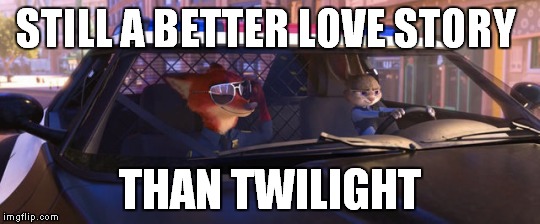
I Just Have a Lot of Feelings; or, On Shipping Nick Wilde and Judy Hopps


I once told myself I wasn't going to watch Zootopia. After the colossal disasters Maleficent and Cinderella, I didn't have much faith in Disney anymore. But after seeing Zootopia's impressive Certified Fresh rating on Rotten Tomatoes and a gentle nudge by a close friend, I decided to see for myself what was good about this revival of Disney's tradition of anthropomorphic animal characters. Well, needless to say, I was hooked. Zootopia is an incredibly intelligent film, a modern fable about racism and prejudice.

Beyond that, it is something of a love story. Seemingly following Frozen's tradition of rejecting romantic love as the only standard of love, Zootopia presents the unlikely friendship of a fox con artist and a rabbit cop. Nick Wilde and Judy Hopps are such strong characters with great chemistry together that fans such as myself cannot resist imagining them as a couple. For weeks since I first saw the film (and I have now watched it more times in the three weeks than I watched Frozen in three years), I indulged myself with plenty of Zootopia fan fiction. I am proud to say that the Zootopia fandom have such talented and intelligent people writing stories I can barely come up with. Many stories further explore the themes of the film. Some present the excitement and danger of police work. And most of these stories use the movie's political themes as a backdrop for the romance of Nick and Judy. It's all incredibly fun to read. However, I have noticed a few patterns that are problematic to me.

A common Fanon dynamic between Nick and Judy is that, being the younger half of the two, Judy tends to be portrayed as the oblivious ingenue. If this trope is active, Nick would be friendzoned until he either makes an Anguished Declaration Of Love or Judy somehow learns that her affection for him is deeper than friendship. And when they do hook up, they get excited about the relationship like teenagers.

Now, I appreciate these writers and their imagination, but I think it goes against the organic development of the two characters' relationship. Their love, regardless of whether it is philia (Platonic love) or eros (romantic love), is based on mutual respect and trust because they overcame their differences and their prejudice against one another. Regardless of what kind of love it is, it is love nonetheless. Their mutual affection is no secret to either of them, so there is little to no need for a big reveal that they love each other. If love has been there all along, it just has to grow into something more, slowly, not suddenly.

Furthermore, these are two adult characters, not teenagers. Judy is 24, and Nick is about 32, possibly the oldest leads in the Disney Animated Canon. I think it's safe to say that they would respond to any ensuing romance differently from our adolescent Disney Princesses. Either they remain friends or make a mutual decision to take their relationship to the next level, whatever that might entail. I imagine the only real drama would be the outside forces that might be working against them.

Friday, October 30, 2015

Flex Like Carrie


For this Halloween, I'd like to celebrate how I became a writer. It was mid-2001, and I was a 13-year-old high school freshman. Unknowingly suffering from depression from near-constant school bullying since age 5, art was my release. But besides drawing for leisure, I was in love with reading. I was also a budding writer at the time. I didn't know it back then because I didn't know that it was actually difficult for some people to express themselves in writing when, in my mind, all I really have to do is use proper grammar, mind my spelling, and use slang with care, and adopt minimal profanity. I was an avid reader, and I might have read most literary classics if it weren't for my depression draining me of energy and enthusiasm for doing the things that I love.

This makes me extremely thankful for a friend of mine for recommending Carrie by Stephen King to me. I was unfamiliar with Stephen King at the time, and until Carrie, the only novels I've read were the Harry Potter books. So, Carrie was a refreshing read for me. The false document style of the novel was ingenious work, quite an achievement for somebody's first novel. Most importantly, as someone who was made to be a social outcast at school, Carrie White was my hero. Reading about how she destroyed the prom and almost everyone there gave me the most satisfying feeling. The prom scene from the 1976 adaptation starring Sissy Spacek did not quite do it justice. 37 years of technological advancement in filmmaking did the trick. When I watched the 2013 adaptation starring Chloe Moretz (who also looked like Carrie from the book), the experience was exactly how I read the book.


Watching this brings me back to that day in the library when I read this scene from the book and just felt so exhilarated that I had to write my "version." Instead, I got a better idea: I wrote an entirely different novel around the idea of a bullied schoolgirl with a supernatural ability. I will not disclose any more details about my novel. The point is that Stephen King's Carrie introduced me to a genre that I love. Beyond just horror, he adopts a degree of magical realism and combines horror elements with prolific storytelling inspired from Alfred Hitchcock and film adaptations of Edgar Allan Poe's works. Stephen King's novels and adaptations of his works don't need many Jump Scares, if any at all. Carrie and The Shining are two of the most effective horror movies where the scare is entirely in the storytelling.

I might not be able to move objects with my mind, but I can write stories well. And perhaps, like Stephen King, I can inspire others, too.

Friday, October 23, 2015

An Artist's Lament: Reacting to Gab Valenciano's Facebook Post


Earlier today, I had a very interesting and insightful chat with a Filipino Uber driver and he said something that stuck...
Posted by Gabriel Valenciano on Sunday, September 13, 2015
I just realized I hadn't Liked or Shared this post until now, because I was so awestruck at Gab Valenciano's message that I read it, contemplated on it for a few moments, and went back to work. (I might have been subtitling an urgent Jimmy Fallon episode at the time.) What struck me about this post is that it gave me an overwhelming relief that I'm not alone, that even the handsome and talented son of an equally handsome and talented singer/actor/dancer feels marginalized in the industry where his own father is being celebrated in nearly three decades now. He's right: It's difficult to be an artist in the Philippines. Specific fields are given especial importance, but individuals aren't typically encouraged to pursue any of them, because we are brought up from childhood to pursue corporate work. When I was a child, everybody's dream job was to work "in an office," like you see on TV, where people work in cubicles and wear slacks and dress shirts and neckties. At the time, my parents were an Air Force pilot and a nurse, which were considerably more active than working "in an office." What on earth do you actually do in an office anyway? While I didn't see anything particularly wrong with that, I didn't see myself in that kind of environment. Even when I began to show signs of artistic talent in both visual art and writing, it didn't occur to me until college that I could pursue art as a career. Neither society nor the educational system encourages the idea. They don't present us with steps to take that path, either. Anyone who expresses the desire to do so is typically discouraged because art in any form is ultimately economically impractical and does not contribute to society whatsoever.

While I am lucky enough to have parents who were happy to let me study Literature in college, it's after graduation that I felt the brunt of the fact that, particularly in this country, art is not a career opportunity. When I search for "writing jobs," all I get are outsourcing companies trying to snag frustrated artists by slapping the word "creative" in their job advertisements. This is why art isn't encouraged. It has little to no value for corporations, who need expendable skilled workers to work for them and pay for their time. There are no such companies actively seeking an artist. Artists have to look for their own ways to earn income; and while the educational system does encourage creativity, it doesn't teach artists how to earn without relegating their art into a useless hobby.

Some might say I bear the mark of my generation, the one that isn't satisfied with having just any little job just to earn some money. But I believe that work isn't just a means to earn money; it is self-fulfillment, and nothing fulfills me more than art. Henceforth, I became determined to find a job where my skills for perfect my art can be exercised. After nearly two years as an article writer in an overworking-but-low-paying SEO reseller, I felt that I was part of a machine rather than a human being creating organic art.

Fast forward to 2015, I am back to working "in an office" - albeit a casual wear office - but it's still an 8-hour job. And while I love my job very much (Who wouldn't want to get paid watching random movies and TV show episodes?), this still isn't what I wanted for myself. I want to be writing the movies and TV series instead of transcribing them. I sought to become a TV writer and revolutionize Philippine TV. However, the steps I have taken did not lead me there. The options available to me could lead me only to corporate work, and only corporate work could give me a stable income. But it would never be fulfilling.

Having read the younger Valenciano's sad post, I realize that I probably couldn't have changed anything even if I did make it into a broadcasting network. While my screenwriting mentor has taught my classmates and me about the value of creative integrity, writers have little control over what happens to their scripts when directors interpret them on the set. At the end of the day, all studios care about is the money they get for giving their target audience what they want instead of what they need. They want modern fairy tales even though they need thought-provoking narratives of multiple genres. It's like giving a child chips and candy when they're clearly in need of vegetables and lean meat. But the television and film industry isn't about to let me give my audience a healthy diet of substance. Jerrold Tarog might have been lucky that his Heneral Luna was met with high regard, but I'm seriously afraid that such beautiful filmmaking won't extend to other genres any time soon because the media is much too engrossed in following silly trends instead of setting them with meaningful stories.


I don't know what's going to happen to me if I do what Gab Valenciano did and go to the US to pursue art. But I do hope that when I do, I'll not only write, but also draw and paint again.

Friday, September 25, 2015

On Heneral Luna


This isn’t going to be a review but merely a reaction.  It is true what people have been saying online about the movie, in the last few weeks.  Filipinos deserve more movies like that--not necessarily socially relevant historical films but rather films that take extra care with aesthetics, context, semiotics, and substance to make us think as much as we feel.

Heneral Luna is a unique historical narrative in that examines the ills of Philippine society and how we’re as awful at handling power and politics as the Philippines under Aguinaldo had been.  It is a retrospective sort of commentary on the fact that, despite everything that our national heroes have done for us, they are a fraction of a greater whole--and the majority, just as they are now, are selfish, undiscerning people with no integrity. It is a lamentation of the fact that people like Antonio Luna is in short supply.  Despite the impact he had made in the Philippine-American War, we weren’t unable to stay independent, largely because we were either incapable of it, or that the powers that be thought we were.

A lot of people in social media seem to get caught in the delusion that we all feel like Antonio Luna.  “Akala mo ba, ikaw lang ang nagmamahal sa Pilipinas?  Mahal ko rin ang Pilipinas!” Buencamino says to him at one point.  The fact that a lot of us are hypocrites like Buencamino; indecisive like Mabini; or, stubborn like Aguinaldo--is a big pill to swallow.  Even for me, the love for country is but an abstract thought.  We can’t all be shooting at the enemy on horseback.  We can’t all be yelling at the President and his council about integrity.  This was exactly the point of the movie.

Lapu-Lapu fought in Mactan; Spain still conquered the Philippines.  They stayed for 300 years despite several rebellions through all that time.  Antonio Luna strove to maintain the independence that Aguinaldo declared in June 12, 1898; the Americans still came to the islands and stayed for the next 40 years.  We needed help from America to drive the Japanese away.

We aren’t like Leonidas and the 300, who held off the Persians and inspired Greece to fight.  We aren’t like Vlad Dracula, who literally scared off the Ottomans by impaling both enemy soldiers and common criminals with tall spikes.  The difference is that both Lapu-Lapu and Luna had their own leaders to answer to, and their bosses didn’t share their sentiments.  Whereas Leonidas and Dracula were kings of their lands and therefore had the power to preserve the sovereignty of their dominion.

I felt the chill of helplessness as the credits rolled and I walked out of the theater.  Everyone including me was inspired by the story we just witnessed.  But I looked around me in the inside of the mall.  Everything I saw was the sign of defeat.  Text and signs in English; pale models in advertisements; foreign brands; local brands modeled after them.  While I personally acknowledge the good parts of foreign influence on Philippine culture, I can’t help but wonder what could have been.  What would the Philippines be like if our ancient kings weren’t diplomatic to a fault?  What if more people shared the fierceness or integrity of Lapu-Lapu, Bonifacio, Luna, or Silang?  What if more people were authentic?  What if Filipinos lived up to their ideals?


Well, if Filipinos value integrity as much as much as we think we do, I would be living in a peaceful and self-sufficient Philippines instead of writing a story around my daydreams of one.

Friday, June 12, 2015

A Woman's Action Movie (Mad Max: Fury Road Review)

I had never watched the original Mad Max movies starring Mel Gibson because I was either not born yet or too young to have watched action movies when the genre was at its heyday in the 80s. It was not until I’ve watched Live Free or Die Hard and The Expendables that my fascination for the genre was awakened. Those movies brought to me the nostalgia of watching my father watch his classic action movies as I momentarily glimpsed the cool action sequences that my father and grandfather and uncles have loved so much.

After seeing positive feedback for Mad Max: Fury Road in BuzzFeed, College Humor, Cracked, and 9GAG, I was compelled to check it out myself. Besides, the impressive cast, including Tom Hardy and Charlize Theron, and younger thespians Nicholas Hoult and Zoe Kravitz, has won me over. But that wasn’t all. Mad Max: Fury Road turned out to be exactly as good as those popular humor websites have claimed.


The action-packed, post-apocalyptic dystopian epic is fun to watch. It has a stunning atmosphere reminiscent of Waterworld, except that the setting is a desert rather than an ocean. The influential but menacing villain and his noisy mooks distinctively reminded me of the Smokers who were constantly after the Mariner and the tattooed little girl in Waterworld. In addition, the costumes and makeup, and the props are impressive. Coupled with the atmospheric camerawork, thrilling score, and breathtaking performances, Mad Max: Fury Road is an awe-inspiring saga of survival and political intrigue.


According to my best friend, Waterworld was actually inspired from the original Mad Max series. This makes me look forward to watching the original series starring Mel Gibson in the title role. I would like to see how much of the original series inspired Waterworld and Mad Max: Fury Road visually and atmospherically.

Furthermore, what’s really refreshing about Mad Max: Fury Road is the refreshingly high number of women who are well-rounded characters in their own right. For the first time, I was watching an action movie made just for me. It’s not at all like other action movies where the female lead is designed to titillate the male target audience, like the Underworld series, the Tomb Raider movies; or worse, Sucker Punch and Lucy. Here, even if Max (Tom Hardy) is clearly the main character, Imperator Furiosa (Charlize Theron) establishes her own story and sustains it throughout the movie. Immediately after the introductory sequences, we are introduced to five beautiful maidens, played by Zoe Kravitz (X-Men: First Class, Divergent), Riley Keough (the villainous romantic lead in Justin Timberlake’s “TKO” music video), Rosie Huntington-Whiteley (the romantic lead in Transformers: Dark of the Moon), and models Abbey Lee and Courtney Eaton. While the five are not as prominent as Furiosa, they are clearly distinguishable characters even though, collectively, they are all the main villain’s brides/sex slaves. Although Furiosa takes it upon herself to protect them, the five brides put up a good fight against anyone who threatens them.


While the brides are literally sex objects in the movie, they are, more importantly, people who want to be anything other than dolls to play with; whereas with action heroines like Selene or Baby Doll, it’s the other way around. Selene, especially, is an fighter whose status as Michael Corvin’s lover doesn’t necessarily define her, but dressing her in a corset and a form-fitting catsuit and then giving her slow-motion shots to emphasize her curves lets you know that, ironically, she is still designed to be a sex object for the audience. The same is true for Baby Doll and her scantily clad posse. Furiosa and her young wards might be nice to look at, but the narrative presents them as much, much more than that by avoiding putting emphasis on their bodies. We get a good look at them when they are first introduced, but any chance of objectification is quickly dashed by using their thin physiques and grimy white dresses to show that they have suffered for it and want to escape, especially the pregnant one with ritual scars on her face.


Like the male characters Max, Nux, and even the villains, they are people letting their claws out to fight for survival in the harsh wasteland. Having Imperator Furiosa, a gang leader who works for the villain, ultimately betray her boss to rescue his young brides from him sets off the familiar feminist narrative. However, it does not play upon the usual gender conflict dynamic as blatantly as Sucker Punch does; instead, our heroines enforce their rights not just as women but as people seeking freedom from oppression, just like our hero Max. When he proves his worth to Furiosa and her wards, they accept his aid and he becomes their protector alongside Furiosa for the rest of the film. They become partners seeking common goals: dignity and freedom from oppression.

Sunday, May 31, 2015

Feminism and Fiction

Betwixt my body image issues and the pervasive debates about feminism online, I realize how and why it's so difficult to portray women in fiction. Game of Thrones and Frozen are two of the works most highly praised for portraying women as complex characters in their own right as opposed to being a love interest (or worse, a one-dimensional villain) for a hero. Frozen and Game of Thrones also came out only a few years ago. This shows that, despite the successes of feminism in making the world a better place for women, the mass media still perpetuate stereotypes about women, even if they try to make a “strong and independent heroine.”

What Frozen and Game of Thrones got right about female characters is that, regardless of alignment, they have multifaceted personalities. They have more to offer than to be something pretty for a male hero to gain as a prize in the end. Being a complex female character doesn’t always require her to forgo traditional feminine traits either. This is somehow revolutionary in the realm of fiction, especially in mainstream pop culture. It’s just sad that this also shows what feminism tends to get wrong about femininity.

 In the past year, feminism has garnered significant backlash from a considerable faction of women in the Internet. The hashtag #womenagainstfeminism gained popularity in social media with quite a bit of help from BuzzFeed. This was in retaliation against misandristic attitudes from women who identify as feminists. Most active in Thought Catalog, BuzzFeed and Tumblr pages, these misandrists promote negative stereotypes about men, such as their penchant for abuse, rape, and violence in general. To them, men are incapable of affection and gentleness; and any woman who enters a relationship with one is either a traitor to feminism or doomed to an unhappy life of betrayal and domestic abuse.

Misandry means “hatred against men,” and there are many feminists who perpetuate this destructive attitude as an aid to promote women’s rights. But many women, especially those who are happy to be in conventional family life, vehemently disagree, with good reasons. They declare, “If advocating my right for respect for my life choices and equal treatment in business and politics means that I have to make jokes about violence against men; make hateful comments about their sex; and assume superiority over men, I don’t want to be a feminist.”

The same problems crop up in various degrees of subtlety in fiction. Emilie Autumn’s Fight Like aGirl album, based on her book The Asylum for Wayward Victorian Girls, has turned a tragic tale of abuse in the mental health institution into an allegory of radical feminism, to the disgust of female fans that are happy with their men. In a twist of irony, the Underworld series, Sucker Punch and, at a lesser extent, Taylor Swift’s music video for “Bad Blood” adopt the “girls with guns” trope as women empowerment despite the fact when it began as, essentially, action porn for men. If feminism demands respect for women, adopting girls with guns as women empowerment undermines this goal, as objectification of women is a major element in the genre.

There is also the faction of fictionists who take a different route. Apparently inspired by Xena: Warrior Princess, there are action heroines like Selene from Underworld and Katniss from The Hunger Games, who challenge the damsels-in-distress stereotype by wielding weapons and holding their own against powerful villains. Both heroines are not only fierce fighters; they are stoic and sarcastic. Besides their physical strength, their behaviors also defy the notion of the emotional woman.

I have a serious problem with that. While I understand that it’s clearly a reaction to the stereotype of a woman character manipulating others with her tears and acting upon her feelings, depicting an emotionless woman seems extreme. Not every woman wears her heart in her sleeve, but it doesn’t mean that a reserved action heroine ought to be perpetually stern or even borderline sociopathic. At least Selene gradually grows out of it when she experiences the joy of love and the fear and grief of losing Michael in the sequels.

Clearly written as a response to Bella Swan of the Twilight books, Katniss Everdeen is her exact opposite. Whereas Bella is gorgeous but doesn’t see herself that way, Katniss is severely malnourished and reasonably unattractive. Making her look acceptable for TV takes considerable effort from her stylists. Whereas Bella Swan is transparent with her feelings, Katniss is largely emotionless. Her first person narrative sounds like she is more of an (albeit spiteful) observer than a terrified teenager (unless she actually cries or becomes scared, which happens only a few times in the whole series). I commend Jennifer Lawrence for adding a layer of emotion to the character in the adaptation  (even though she doesn’t look the part at all). But I digress. Being excessively showy of emotion is merely a symptom of a usually bigger problem with a female character. But taking away emotion to enforce physical as well as mental strength for an action heroine seems rather shallow for me. It’s shallow because it doesn’t necessarily add to her character; it only reduces her femininity.

However, few people realize that about heroines like Katniss. Katniss has become the epitome of the “strong and independent female character” while female characters that still practice traditional gender roles are supposedly anti-feminist. Radical feminists criticize Molly Weasley for being a housewife to a man who works for the Ministry of Magic. They criticize Bella Swan for being “passive”; dependent to her men; and adopting traditional gender roles like keeping house and cooking for her father (more on this in an upcoming blog).

The problem with feminism is that it focuses more on combatting patriarchal oppression than celebrating femininity. It reinforces the idea that “women can be as good as men in everything,” so we must abandon traditional female roles and strive to gain success alongside men in business and politics, science and medicine, architecture and engineering, art and music and literature, and also in aviation and the armed forces.  there is nothing wrong with being a doting mother or a housewife as long as the stay-at-home mom is happy with it. Like all stay-at-home moms, Molly Weasley is constantly busy keeping house and raising children, including rambunctious twins Fred and George. In other words, it’s very hard work that must be appreciated and honored, especially by feminists.

Don’t get me wrong. There’s nothing wrong with action heroines. Wonder Woman is a powerful super-heroine whose definitive trait is her compassion. But that doesn’t negate the fact that she will rightfully punish evildoers.

Beatrice “Tris” Prior from the Divergent series is a great action heroine not just because she can kick ass but also because she’s worked extremely hard to be able to do so. She’s special but she’s not the only one. The interesting thing about Tris is that, like Katniss, she is not particularly beautiful but that’s not relevant to the character. (This is one of the good things about Katniss as well.)

A heroine doesn’t need to be eye candy to be taken seriously, after all. Inversely, a heroine can still be beautiful but, like Wonder Woman, that’s not her most important trait.

Tris has fierceness about her, but also gentleness. Unlike with Selene or Katniss, the two traits do not negate each other. Tris never had to “discover the hidden softness under her hard core” like Selene or Katniss had to do because even though compassion doesn’t come naturally for Tris, she is considerate, friendly, and polite. The two traits are within her all along, as it is for all women.

Therefore, I would like everyone to learn that women are complex and ought to be written that way in fiction. We are indeed strong, but that can mean more than physical strength and combat skill. Wearing dresses and makeup, taking upon domestic tasks, or settling down does not make a woman less “strong and independent.” An ideal heroine is someone who can be any woman. She may or may not be beautiful; she may or may not care for her appearance. She may or may not be a combatant. She may or may not be a good person, even. But she is a whole person, nonetheless. The ideal heroine is one who feels for the other characters and what happens to them and her. She has dreams and desires. She has flaws and nuances. Not everyone might like her, and that’s okay. But she won’t take kindly to being insult or discrimination.